Good custom event shirts come down to five decisions made in the right order: who wears them and for how long, what the design needs to say, which fabric and print method suit the Singapore climate and your quantity, which sizes and artwork details you lock in, and how the shirts reach people on the day. Get those right and the shirt does its job: it makes a crowd look like one team. This guide walks through each decision for schools, companies, non-profits and event organisers.
TL;DR
- Decide the shirt’s job first (identify staff, unite a team, or give attendees a keepsake). Fabric, print method and design follow from it.
- Keep the design simple: one strong idea, a readable front, and a placement that still works when the wearer is moving.
- In Singapore’s heat, breathable fabric matters as much as the artwork. Match the print method to your quantity and number of colours.
- Confirm artwork files, size breakdown, colours and delivery date in writing before production starts.
- Plan distribution and care from the start: label by size, hand out early, and include simple wash advice.
Table of Contents
- Start with what the shirt has to do
- Design ideas that work for schools, businesses and non-profits
- Design rules for comfortable, readable and memorable shirts
- Fabric and print method: matching them to Singapore and to your order
- What to confirm before you order
- Corporate event shirts that show your brand and sort your teams
- Our perspective: simple, well-planned shirts win
- Handing out and caring for event shirts
- Planning event shirts with us
- FAQ
- Sources
Start with what the shirt has to do
Before anyone opens a design file, write one sentence: “These shirts are for ___, worn at ___, by ___.” The answer changes almost every later choice.
- Identification shirts (volunteers, organising committee, event crew) must be seen quickly from a distance. Bold colour, large lettering and a role label on the back matter more than clever art.
- Team and group shirts (class camps, CCAs, department days, company retreats) are about belonging. A shared emblem, a theme and perhaps names or nicknames work well.
- Attendee shirts (runs, conferences, charity drives) are keepsakes. People will wear them again only if they are comfortable and not covered in sponsor logos.
Also count the wearers early and settle who pays. A school camp funded by parents, a company-funded townhall and a charity run where participants buy their own shirt have very different budgets, and the budget decides how many colours and which fabric you can afford.
Design ideas that work for schools, businesses and non-profits
A useful example of a design doing real work comes from Singapore’s volunteer sector. Team Nila introduced a standardised volunteer T-shirt design and a new uniform featuring a lion emblem symbolising national pride, courage and resilience. The lesson for any organiser: a single emblem with a clear meaning gives people something to rally behind, and a standard design makes a large group instantly recognisable.
Schools, CCAs and camps
- A class or house mascot drawn simply enough to print in one or two colours.
- A camp theme or slogan on the front, with the full name list or group name on the back.
- Year and batch numbers, which make the shirt a keepsake for graduating students.
- Bright, distinct colours per group, so teachers can spot a stray student at a glance.
We cover this in more depth in our guide to T-shirt printing for schools, CCAs and camps.
Corporate events and company days
- A small, tasteful logo on the chest with a larger theme graphic on the back.
- Team colours at team-building days, so teams can identify each other without bibs.
- A shared inside joke or event slogan that staff will actually want to wear again.
- Role-based variations (for example one colour for hosts, another for participants).
For more angles, see our list of creative T-shirt printing ideas for corporate events and our guide to corporate T-shirt printing for team building and promotions.
Non-profits and charity events
- Put the cause first and sponsors second. A crowded sponsor wall makes a shirt feel like an advertisement and people leave it in the cupboard.
- Use one memorable line or symbol that supporters are proud to be seen in.
- Consider a small sponsor strip on the sleeve or lower back instead of the front.
Design rules for comfortable, readable and memorable shirts
Three tests catch most design problems.
The five-metre test. Print the design at actual size on paper, hold it against your chest and step back. If you cannot read the main words from five metres, the lettering is too small or too thin.
The contrast test. Pale text on a light shirt, or dark text on navy, disappears in daylight and in event-hall lighting. Pick a high-contrast pair and limit yourself to two or three colours. Fewer colours also usually keep production simpler.
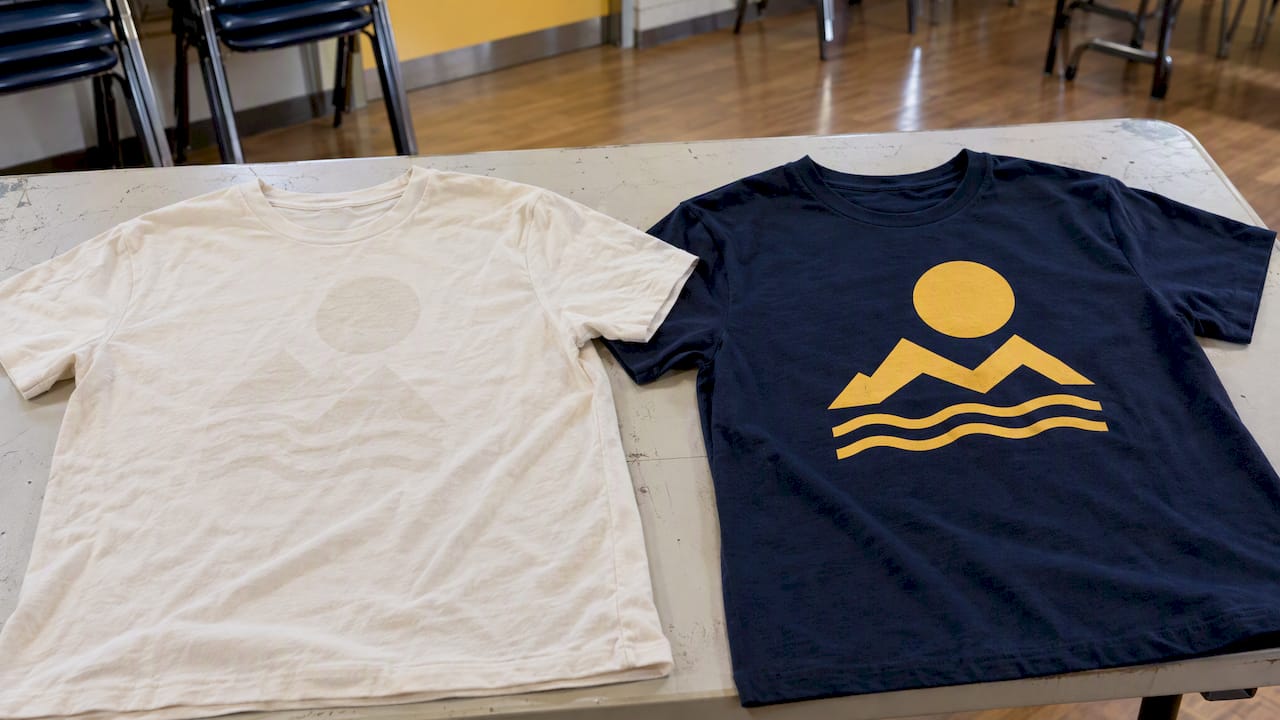
The movement test. Shirts get stretched, tucked and layered under lanyards or bibs. Keep key content away from the armpit and the lower hem, and avoid placing text where a lanyard or bag strap will cover it.
A few further habits help:
- Use one typeface, or two at most. Bold sans-serif styles read best at a distance.
- Leave empty space. A design that fills the whole chest looks heavy and feels hot on the skin when it is a large solid print.
- Put the main message on the front and the extras (names, sponsors, dates) on the back or sleeve.
- Ask a few people from the actual group to review the draft. A phrase that seems funny to the organising team can land badly with others.
Our guide to choosing the right T-shirt design for your event goes further on layout and placement.
Fabric and print method: matching them to Singapore and to your order
Fabric
Singapore is hot and humid all year, so the fabric decision is about comfort first.
| Event type | What to prioritise | Typical fabric direction |
|---|---|---|
| Outdoor runs, sports days, camps | Breathability, quick drying | Lightweight performance or sports fabrics |
| Indoor conferences, company dinners | Soft feel, neat appearance | Cotton or cotton blends, polo styles |
| Giveaways to large crowds | Cost control, easy sizing | Standard cotton round-neck tees |
| Staff on duty for long hours | Durability, wash-after-wash shape | Blends that keep shape |
Dark, thick cotton under the sun is the classic mistake. If people will be moving outdoors for hours, choose a lighter or performance fabric even if it costs more per piece. Our guide to choosing the right T-shirt material for printing in Singapore compares the options in detail.
Print method
The three methods you will hear about most are:
- Screen printing: each colour is applied through its own screen. It is well suited to larger quantities with simple, solid-colour artwork, because the set-up work is spread over many shirts.
- Digital (DTG) printing: the design is printed directly onto the fabric. It suits detailed, multi-colour or photographic artwork and smaller runs.
- Heat-transfer vinyl: cut shapes of vinyl are pressed onto the shirt. It is a common choice for names, numbers and small personalised additions.
A practical way to choose: many identical shirts with a one- or two-colour design usually points to screen printing; a small batch or a complex design points to digital; individual names on top of a shared design points to vinyl for the personalised part. You can also combine methods on one shirt. Read our comparison of screen printing, DTG and vinyl or our broader guide on how to choose the best printing method for the trade-offs. Ask any printer for a sample or a mock-up before a large run, and tell them how many colours you plan to use, since that affects the method.
What to confirm before you order
Most event-shirt problems are preventable with a short checklist agreed in writing. Use this one.
- Quantity and size split. Collect sizes before ordering, not after. Ask people for a size using a physical size chart, because sizing differs between cuts. Add a small buffer for late joiners and replacements.
- Cut and fit. Decide whether you need men’s, women’s or unisex cuts, and whether any group needs different garments, such as long-sleeve or modest-wear styles.
- Artwork files. Send the highest-quality version of logos you have, ideally vector files, and tell the printer the exact print size and placement on front, back and sleeves.
- Colours. Name the shirt colour and each ink colour. Screen colours differ from printed ones, so ask for a proof or a physical sample when brand colours matter.
- Personalisation list. Names, numbers and roles should be supplied in a spreadsheet, checked by someone other than the person who typed it. Spelling mistakes on 200 shirts are expensive.
- Sign-off. Approve the final mock-up in writing, including spelling, colours and placement.
- Timeline. Work backwards from the event date: design approval, production, packing and delivery. Leave a few days of slack for reprints or last-minute changes.
- Delivery details. Confirm the address, who receives the boxes, and whether shirts should be packed by size, group or individual name.
If you are comparing providers, our list of 10 things to consider before choosing a T-shirt printing company is a useful checklist for those conversations.
Corporate event shirts that show your brand and sort your teams
A corporate shirt has two audiences: the people wearing it and the people looking at it. For wearers, comfort and a design they will not feel awkward in decide whether the shirt gets worn. For onlookers, clarity matters: who are these people, and who do they work for?
Some practical decisions:
- Use brand colours carefully. A corporate palette that looks good on a slide may not suit a shirt. A single brand colour as the shirt with a white or black logo is often cleaner than a multi-colour logo on a patterned design.
- Separate teams with colour, not clutter. At a company day with competing teams, colour is the quickest identifier. Add a team name on the back if you need to be certain.
- Differentiate roles. Event hosts, speakers and support staff should be visibly different from participants, so guests know whom to ask for help.
- Think about the second life of the shirt. Staff who wear it to the gym or at weekends give you free visibility. That only happens when the design is understated.
If the shirts will double as regular workwear, look at our page on company uniform shirt printing. For the wider branding picture, read how event T-shirt printing boosts brand visibility.
Our perspective: simple, well-planned shirts win
We print shirts for schools, businesses, non-profits and event organisers, and the pattern repeats from one project to the next. The shirts that people keep wearing are rarely the most elaborate. They have one clear idea, a fabric that does not trap heat, and a fit that was checked before the order went in.
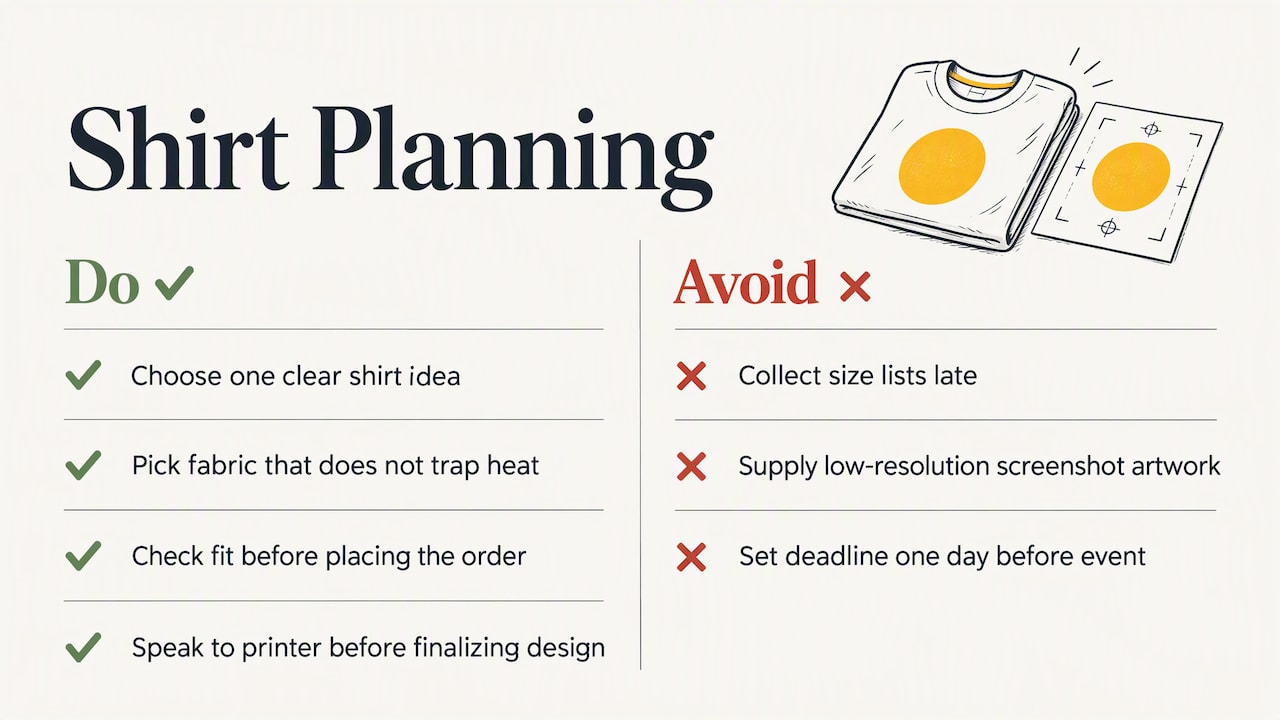
The mistakes we see most are practical rather than creative: size lists collected late, artwork supplied as a low-resolution screenshot, or a deadline set a day before the event with no room to correct a typo. That is why we look after the whole process, from design and planning through printing, packing and delivery, so that one team can catch these issues before they reach production.
Our advice if you are ordering for the first time: speak to the printer before you finalise the design, not after. A short conversation about quantity, colours and timing often changes the design for the better and saves money.
— Tommy
Handing out and caring for event shirts
The event does not end when the boxes arrive. How you distribute shirts affects how smoothly the day starts.
- Pack by group or by size. For a school camp, pack by class or group with a list inside. For a large public event, pack by size so registration desks can hand out quickly.
- Hand them out early. Distribute shirts before the day where possible, so mistakes in size can be swapped. If everyone changes at the venue, you need a changing area and a swap table.
- Keep a spare stock. Hold back a few shirts in common sizes for last-minute additions and for volunteers who spill something.
- Send care advice with the shirt. A short note, or a line in the event briefing, is enough. Turn the shirt inside out, wash with similar colours and avoid high heat.
The advice matches what official and professional bodies recommend for everyday laundry. Singapore’s National Environment Agency suggests washing clothes at room temperature where possible and washing full loads, which saves energy. Textile-care body GINETEX recommends sorting laundry by soil level, treatment and colour, checking colourfastness and washing at lower temperatures. Always follow the care label on the shirt itself, since it reflects the actual fabric.
Planning event shirts with us
If you are organising a school camp, a company event, a charity drive or a conference, our event T-shirt printing service covers design and planning, printing and packing, and delivery. We offer full customisation of design, material and delivery, and we also produce sportswear, caps, jackets and Muslimah attire for groups that need more than a standard tee. Browse our T-shirt printing portfolio for examples, then tell us about your event with your quantity, date and ideas, and we will take it from there.
FAQ
How early should I order custom event shirts?
Start as soon as the event date and headcount are roughly known. Allow time for design drafts, a mock-up approval, production, packing and delivery, plus a few spare days for corrections. Rush jobs are possible, but they leave no room for mistakes, so ask your printer for realistic timings for your quantity.
Which print method is best for event shirts?
It depends on your quantity and artwork. Simple one- or two-colour designs in large quantities usually suit screen printing, while detailed or full-colour designs in smaller batches suit digital printing. Vinyl is a good fit for names and numbers. A good printer will recommend one after seeing your artwork and order size.
What file should I send for printing?
Send your logo and artwork in the highest quality you have, ideally a vector file, rather than a screenshot or a photo of a screen. Tell the printer the print size and where it sits on the shirt. If you only have a low-resolution file, ask the printer whether it can be redrawn before production.
How do I choose sizes for a large group?
Collect each person’s size using a physical size chart or a sample shirt, not guesses. Order a small buffer in common sizes for late joiners and mistakes. For events where many people are unsure, a sample set of sizes at registration helps people swap quickly.
Sources
- Team Nila Volunteers Recognized At Awards Ceremony
- Energy Saving Tips by Appliance, National Environment Agency
- Textile care symbols, GINETEX
Recommended
- The Complete Guide to Choosing the Right T-Shirt Design for Your Event
- Custom T-Shirt Printing in Singapore: Everything You Need to Know Before Ordering
- 10 Creative T-Shirt Printing Ideas for Your Next Corporate Event
- A Complete Guide to T-Shirt Printing in Singapore: Materials, Printing Methods, and Costs