DTF (direct-to-film) shirt printing prints your artwork onto a special film, coats it with adhesive powder and presses it onto the fabric with heat. It gives full-colour results, including photos and gradients, on light and dark shirts, and it works for small and mixed orders. For a school camp with 12 different house designs or a company event with a gradient logo, it is often the practical choice. For 300 identical shirts in one colour, it often is not. This guide explains how the process works, where it fits, what to expect on price and timing, and what to prepare before you order.
TL;DR
- DTF prints the design on film first, then heat-presses it onto the shirt, so full colour and dark fabrics are not a problem.
- It suits short runs, multi-colour artwork and mixed designs. Screen printing usually wins on cost once many identical shirts are needed.
- Singapore reference prices for DTF sit around S$8 to S$18 per shirt, depending on supplier, artwork and fabric.
- Cotton and cotton-rich fabrics are the safest base. Waxed, coated or water-repellent fabrics can fail to hold the adhesive.
- Send vector or high-resolution artwork, final sizes and a firm delivery date to avoid delays.
Table of Contents
- What DTF shirt printing actually is
- How the process works, step by step
- Which shirts and fabrics suit DTF
- DTF compared with other printing methods
- What DTF shirt printing costs in Singapore
- Durability and care
- How long it takes and what to prepare
- Buying a DTF printer versus ordering prints
- Our view: pick the method after the brief
- Planning a group order?
- FAQ
- Sources
What DTF shirt printing actually is
The name says it: the design goes onto a film, not straight onto the shirt. A printer lays down the colour image with water-based inks, and for dark shirts adds a white layer underneath so the colours stay bright. Kodak’s film printing guide describes hot-melt powder being applied to the wet print and cured, after which the film is pressed onto pre-pressed fabric and peeled away.
In practice, that means the print is made as a transfer. The shirt itself never goes through a printer, which is why DTF copes with fabrics and shapes that other digital methods struggle with, and why a shop can prepare transfers ahead and press them quickly.
You will see the same thing called DTF t-shirt printing or direct to film printing. They are one method.
How the process works, step by step
Knowing the sequence helps you judge a quote and spot where quality is won or lost. The steps below follow the published guides from equipment makers, including xTool’s heat transfer process guide.
- Print the film. The artwork is printed onto the film, with white ink behind the colours when the shirt is dark.
- Apply the powder. Adhesive powder is spread evenly over the wet ink.
- Cure the film. The powder is baked so it melts into the ink layer. Kodak’s guide gives example settings of 110 to 125°C for 2 to 3 minutes, and notes that results vary with conditions.
- Pre-press the shirt. A short press removes moisture and creases from the fabric.
- Press the transfer. The film goes ink-side down and is pressed with heat. Kodak’s example is 150 to 165°C for 8 to 10 seconds.
- Cool and peel. The film is peeled once it has cooled, as xTool describes, and a final re-press settles the print into the fibres.
Those temperatures are manufacturer examples, not a promise about any one shop’s settings. The point for a buyer: a good result depends on correct curing, even pressure and a final press, not only on the printer. Roland DG’s DTF guide gives the same overall picture: water-based inks, adhesive powder, then heat and pressure.
Which shirts and fabrics suit DTF
DTF is forgiving, but not unlimited. Cotton and cotton-rich blends are the easiest base: they take the transfer evenly and are what most school and corporate tees are made from. Polyester and dri-fit sportswear can be done, but the shop needs to use the right transfer type and press settings, because polyester reacts badly to excess heat and dyes can migrate into the print.
Surfaces to treat with caution:
- waxed or silicone-coated fabrics
- water-repellent or windbreaker-type finishes
- heavily textured weaves
- nylon and non-woven materials
The adhesive may not bond reliably to any of these. That matters in Singapore, where many CCA and sports orders include dri-fit tees, singlets and light jackets. If your order mixes fabrics, ask for a test press on a sample of each before approving the full run. A good printer will tell you plainly if one garment is a poor candidate rather than press it and hope.
Design-wise, DTF handles photographs, gradients, fine lines, small text and many colours at no extra cost per colour. That is its real strength against screen printing, where each colour is a separate screen.
DTF compared with other printing methods
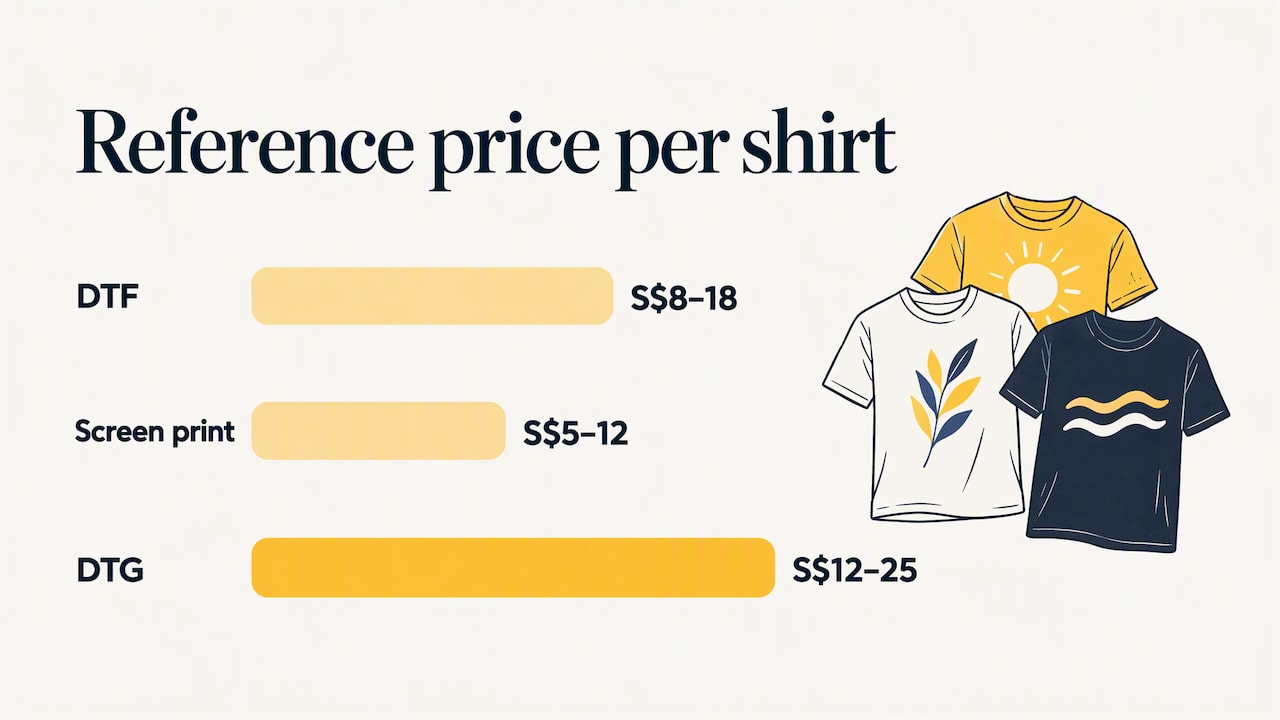
No method is best for everything. The comparison below uses Singapore reference ranges from a local pricing guide published in December 2025. Treat the figures as market indications, not quotes: actual prices move with supplier, artwork complexity, fabric and quantity.
| Method | Reference price per shirt | Best for | Weak spot |
|---|---|---|---|
| DTF | S$8 to S$18 | Full-colour art, small or mixed runs, dark shirts | Costs more per shirt than screen printing at volume |
| Screen printing | S$5 to S$12 | Large runs of one design with few colours | Setup per colour, so poor for small mixed batches |
| DTG | S$12 to S$25 | Detailed prints on cotton, very small runs | Highest price band, fabric-sensitive |
The same guide says silkscreen becomes the most cost-effective option above about 30 pieces, while DTF suits mixed designs and small quantities. That matches what organisers tell us: a batch of 25 shirts in five different designs is a DTF job, and 400 identical event tees in two colours is a screen printing job.
If you want the longer comparison, our own guides cover screen printing against DTG and vinyl and how to choose the right method for a business, school or event.
What DTF shirt printing costs in Singapore
The local reference range is S$8 to S$18 per shirt, with minimal setup and a typical minimum order of 5 to 10 pieces, according to the same December 2025 guide. Some shops advertise no minimum at all, and others price from a few pieces. Four things move the number most:
- Print size. A chest logo costs far less than a full-front or back print, because film and ink use scale with area.
- Number of placements. Front, back and sleeve prints each add to the price.
- The shirt itself. A plain cotton tee and a dri-fit tee have different blank costs, and sizes above XXL often cost more.
- Quantity. Per-shirt price falls as quantity rises, but less steeply than with screen printing.
When you compare quotes, ask what is included: the blank shirt, design adjustments, packing by name or size, and delivery. A low print price with extras added later is not a low price.
We do not publish fixed prices on our site, because the right quote depends on garment, quantity and artwork. Send us the brief and we will price the whole job.
Durability and care
DTF prints are meant to last through regular wear, but no honest source gives a fixed number of washes. Kodak’s guide recommends a post-press to improve wash and rub fastness, which tells you where durability comes from: the finishing step. Ask any printer whether they post-press.
Sensible care for any heat-transferred print:
- Turn the shirt inside out before washing.
- Use a gentle cycle and avoid harsh detergents.
- Skip the tumble dryer where you can. Singapore’s humidity means air-drying in a ventilated spot works well anyway.
- Never iron directly on the print. If you must, iron the shirt inside out.
For school and company orders, include a one-line care note with the delivery. It costs nothing and cuts the complaints that arrive after the third wash.
How long it takes and what to prepare
DTF is quicker to set up than screen printing because no screens are made, so shops can often turn small orders faster. Real lead times, though, depend on the shop’s queue, the blank stock and how fast you approve the design. Quote times in Singapore range from same-day for very small runs to a week or two for larger or busier periods, so always get a committed date in writing, especially around exam periods, National Day and year-end event season.
Before you ask for a quote, prepare:
- Artwork. A vector file (AI, EPS or PDF with text outlined) is best. If you only have a picture, send a high-resolution PNG or JPEG, ideally 150 to 300 PPI at the printed size.
- Placement and size. Where the print sits and how wide it is, in centimetres.
- Garment details. Fabric, colour, cut and the size split by head count. Collect sizes early, because late changes are the commonest cause of delay.
- Names and numbers. If each shirt carries a name, supply a clean spreadsheet.
- Deadline and delivery. The event date, plus a buffer of a few days, and the address or addresses for delivery.
- Approvals. Decide who signs off the proof, so one person gives one final yes.
Buying a DTF printer versus ordering prints
Some organisations ask whether it is cheaper to buy a machine. One US maker lists a desktop DTF printer at USD 2,699, with all-in-one bundles at USD 3,799 and USD 5,299, and ships only within the contiguous United States. That is just the equipment. You would still need film, powder, ink, a heat press, ventilation, staff time and test runs before shirts come out consistently. Unless you print every week, ordering from a specialist is cheaper and carries less risk.
Our view: pick the method after the brief
We handle jobs from design to delivery for schools, businesses, non-profits and event organisers, so we see the same mistake often: people choose a printing method first and the order second. Start from the order. How many shirts, how many designs, which fabric, what deadline?
A few rules we work by:
- Many colours or a photographic design in a small run: DTF is usually the answer.
- A large run of a simple one or two-colour design: ask about screen printing too.
- Dri-fit, jackets and unusual fabrics: test first, then commit.
- A fixed event date: work backwards from it and approve artwork early, because artwork approval is where most orders stall.
We would rather tell you a method does not suit your fabric than print it and have it fail at your camp. Our method-choice guide walks through the same trade-offs in more depth.
— Tommy
Planning a group order?
We produce custom T-shirts, sportswear, jackets and caps for school camps, CCAs, corporate events and non-profit drives, and we manage design, printing, packing and delivery. Tell us your quantity, fabric and deadline, and we will recommend the right method and quote the whole job. Start from our T-shirt printing services page, or see finished work in the printing portfolio.
FAQ
Is DTF printing good for shirts?
Yes, for full-colour or small-batch work it is a strong option, and it prints well on dark fabric thanks to the white ink layer. Durability depends on correct curing and a final press, so ask your printer about both. Fabrics with waxed, coated or water-repellent finishes are the main exception.
How much should a DTF print cost in Singapore?
A published local reference puts DTF at about S$8 to S$18 per shirt, varying with print size, fabric and supplier. Larger prints and multiple placements push the price up. Ask for a quote that includes the blank shirt, packing and delivery.
Is DTF better than screen printing?
It depends on the order. DTF is better for many colours, photos and small or mixed runs. Screen printing generally becomes cheaper per shirt once you pass roughly 30 identical pieces, according to the same local reference.
How long does a DTF shirt printing order take?
It varies by shop, quantity and how quickly artwork and sizes are confirmed. Small orders can be quick, but busy seasons stretch lead times. Agree a delivery date in writing before you approve the proof.
What file should I send for DTF printing?
A vector file with outlined text is ideal. If you only have a raster image, send a high-resolution PNG or JPEG at the printed size, with a transparent background where the design has one.
Sources
- Kodak, Hot Peel Film Printing application guide
- xTool, DTF printing heat transfer process guide
- Roland DG, Guide to DTF printing
- Custom T Shirt Singapore pricing guide, December 2025
- OBZIY DP1 series DTF printer
Recommended
- A Complete Guide to Choosing the Right T-Shirt Material for Printing in Singapore
- A Complete Guide to T-Shirt Printing in Singapore: Materials, Printing Methods, and Costs
- 10 Things to Consider Before Choosing a T-Shirt Printing Company in Singapore
- Custom T-Shirt Printing in Singapore: A Complete Guide for Businesses, Schools, and Events