A fundraiser T-shirt works because supporters pay for something they will wear, and the margin between your cost and your selling price goes to the cause. In Singapore the shirt is the easy part. The parts that decide whether you raise money are the quantity you order, the price you set, how openly you say where the proceeds go, and whether your appeal needs to be disclosed to the Commissioner of Charities. This guide covers all four, for schools, businesses, non-profits and event organisers.
TL;DR
- Work out your cost per shirt, your selling price and your break-even quantity before you design anything. The gap between them is what you raise.
- Pick one clear goal or message for the shirt. A shirt that says what the money does sells better than a generic logo.
- Say in plain words where the money goes, and check whether your appeal must be disclosed on the Charity Portal or whether GST applies.
- Order from a printer that handles design, printing, packing and delivery, so your volunteers only have to sell.
- Set a pre-order deadline, share it early and order once, to avoid dead stock.
Table of Contents
- How a T-shirt fundraiser makes money
- Shirt ideas that suit different organisers
- Plan the campaign before you design
- Pricing and estimating what you will raise
- Choose the garment and print method
- What the rules say in Singapore
- Perspective: what we see go wrong, and right
- Get your fundraiser shirts printed
- How to promote the shirt and get people to buy
- Checklist before you place the order
- FAQ
- Sources
How a T-shirt fundraiser makes money
The mechanics are simple. You pay a printer a fixed cost per shirt. You sell each shirt for more than that. The difference, after any other costs, is your contribution to the cause.
There are two common ways to express this to supporters:
- A fixed amount per shirt. One Singapore example is a charity cycling event where, for every event jersey bought, $30 went to the beneficiary charity. Supporters like this because the number is concrete.
- A percentage or the net surplus. This suits smaller runs where final costs are not known until the order is done.
Either approach works. What matters is that you state it before people pay, and that the number you state is the number you deliver.
Shirt ideas that suit different organisers
The best fundraising shirt ideas tie the design to a reason for wearing it. Here is what tends to work for the groups we print for.
Schools, CCAs and class camps
Schools usually have a built-in audience: students, parents, alumni and staff. Good formats include a house or class shirt sold during a charity week, a CCA shirt where part of the price funds a cause, and a commemorative shirt for a school anniversary or service-learning project. If you are also ordering shirts for your own members, our guide to affordable CCA T-shirt printing options for schools explains how to keep the unit cost down, and what to know before ordering for schools, CCAs and camps covers the practical checks.
Non-profits and charities
A charity shirt is both income and awareness. Put the cause name, a short line about what the money does and your logo on the front or sleeve. Single-number goals, such as a set number of meals or bursaries, give supporters something to rally around and give you an easy progress update to post later.
Companies and CSR drives
Companies can sell shirts to staff, with the margin donated, or give shirts to volunteers on a charity day. Because staff already identify with the brand, a co-branded shirt (company logo plus the cause) often sells well internally. Our page on corporate T-shirt printing for team building, events and promotions shows how those orders are usually set up.
Walks, runs and one-off events
Charity runs, walkathons and carnivals suit a shirt that doubles as participant gear. Participants wear it on the day, and the registration fee or an add-on covers the contribution. For event-specific planning, see our custom event shirts planning guide.
Design angles that raise more
| Idea | Best for | Why it works |
|---|---|---|
| One-line goal on the chest | Charities, schools | Supporters know what they are funding |
| Event date and place on the back | Runs, carnivals | Becomes a keepsake |
| Class, house or team names | Schools | Pride drives group orders |
| Limited colourway | Companies, alumni | A deadline creates urgency |
| Kids and adult sizes | Family events | Whole families buy together |
Plan the campaign before you design
Most fundraisers that disappoint skipped the planning. Settle these points first.
- The goal. How much do you want to raise, and what will it fund?
- The audience. How many people can you realistically reach? Be honest: a typical response is a fraction of those you contact.
- The model. Pre-order only, or stock for sale on the day?
- The timeline. Allow time for design approval, production and delivery before the event, and add a buffer.
- The person in charge. One volunteer should own sizes, payments and collection.
Pre-order is the safer model. You print only what is paid for, so you carry no unsold stock. Selling on the day can raise more per shirt through impulse buying, but you take on the risk of leftover sizes.
Pricing and estimating what you will raise
You need three numbers.
- Cost per shirt: the printer’s quote for your quantity, including the printing method, number of colours and print positions, plus any packing and delivery.
- Selling price: what supporters pay.
- Other costs: payment fees, volunteer expenses, promotional material.
The formula is: (selling price minus cost per shirt) times shirts sold, minus other costs, equals amount raised.
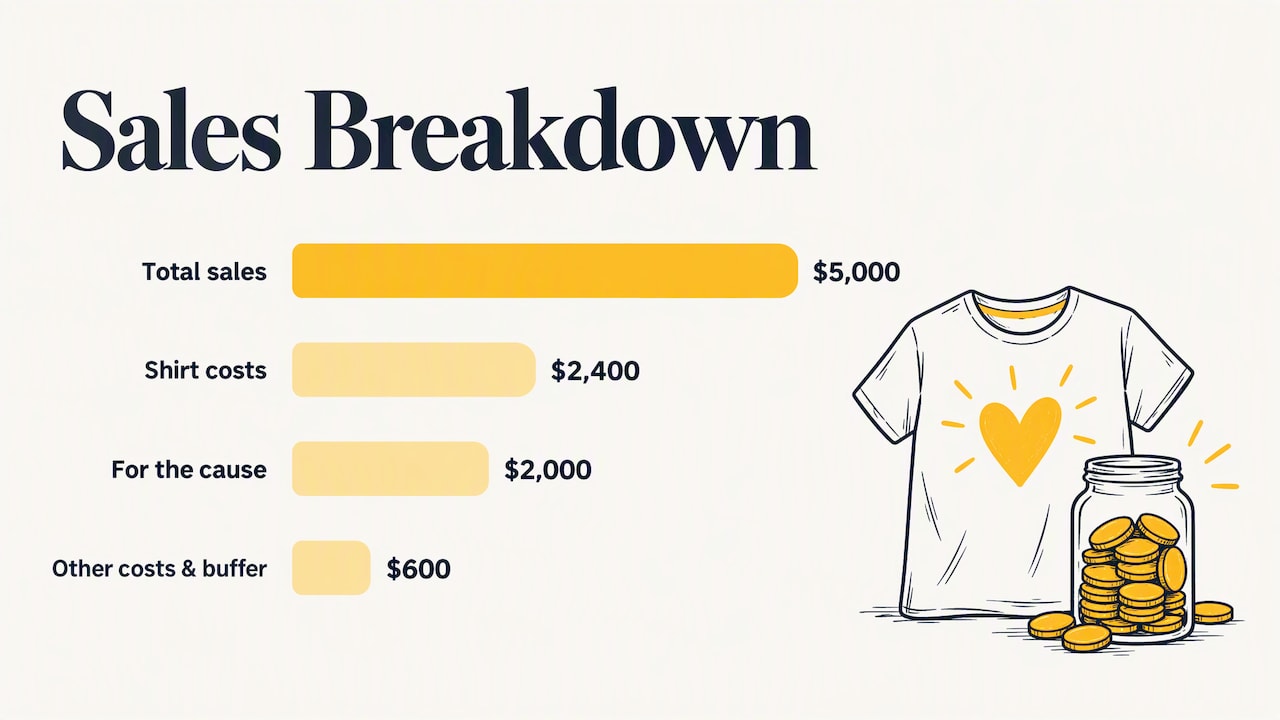
Here is a worked example with made-up figures, to show the method only. Suppose a shirt costs $12 all in and you sell it at $25. You keep $13 per shirt. If you sell 200, that is $2,600 before other costs. If you promised $10 per shirt to the cause, you would raise $2,000 and keep $600 to cover other costs and a buffer. Your own quote will differ, so replace these numbers with real ones.
Per-shirt cost usually falls as the quantity rises, because set-up work is spread over more units. That tempts organisers to over-order. Resist it: ordering 50 more shirts to save a little per unit loses money if 30 stay in a cupboard. Use sign-ups to set the quantity, then add a small margin for late buyers.
We do not publish fixed prices because cost depends on the garment, method, colours and quantity. Send us your numbers and we will quote against your target.
Choose the garment and print method
For fundraising, comfort and durability matter more than anything clever. People only keep wearing a shirt that feels good, and that is how it keeps promoting your cause.
- Fabric and fit: a standard cotton or cotton-blend tee suits casual wear. A performance or dry-fit fabric suits runs and sports days. Offer a range of sizes, including children’s.
- Print method: screen printing is usually economical for larger runs with few colours. Digital printing suits detailed, multicolour artwork in smaller runs. Heat transfer and vinyl suit names and numbers. Our comparison of screen printing, DTG and vinyl helps you pick.
- Artwork: keep it simple and high contrast. If you do not have a designer, these tips for non-designers will help your design print cleanly.
Beyond tees, some groups add caps, jackets or windbreakers to the range. A jacket costs more, so treat it as a premium option rather than the main product.
What the rules say in Singapore
This is where charity shirts differ from ordinary group orders. The details below come from official sources. For your own situation, confirm with the Commissioner of Charities or, for tax questions, with IRAS or your accountant.
Be clear about where the money goes
The Commissioner of Charities states that fund-raisers must give accurate, non-misleading information, and disclose the organisation, the intended use of funds and whether a commercial fund-raiser is involved. In practice, put one sentence on your order page and posters: who is raising the money, what it funds and how much of each sale goes to it.
If you are raising funds on behalf of a registered charity or an Institution of a Public Character (IPC), the same guidance says you should have a written agreement stating the percentage of proceeds, the timeframe and any fund-raiser fees. Get that signed before you order shirts, not after.
Charities and IPCs are also expected to keep their fund-raising efficiency ratio below 30%, meaning fund-raising expenses divided by gross fund-raising receipts for the financial year. If you are a school or company helping a charity, remember that shirt costs count towards the charity’s expenses where they are part of its fund-raising.
Public appeals and disclosure
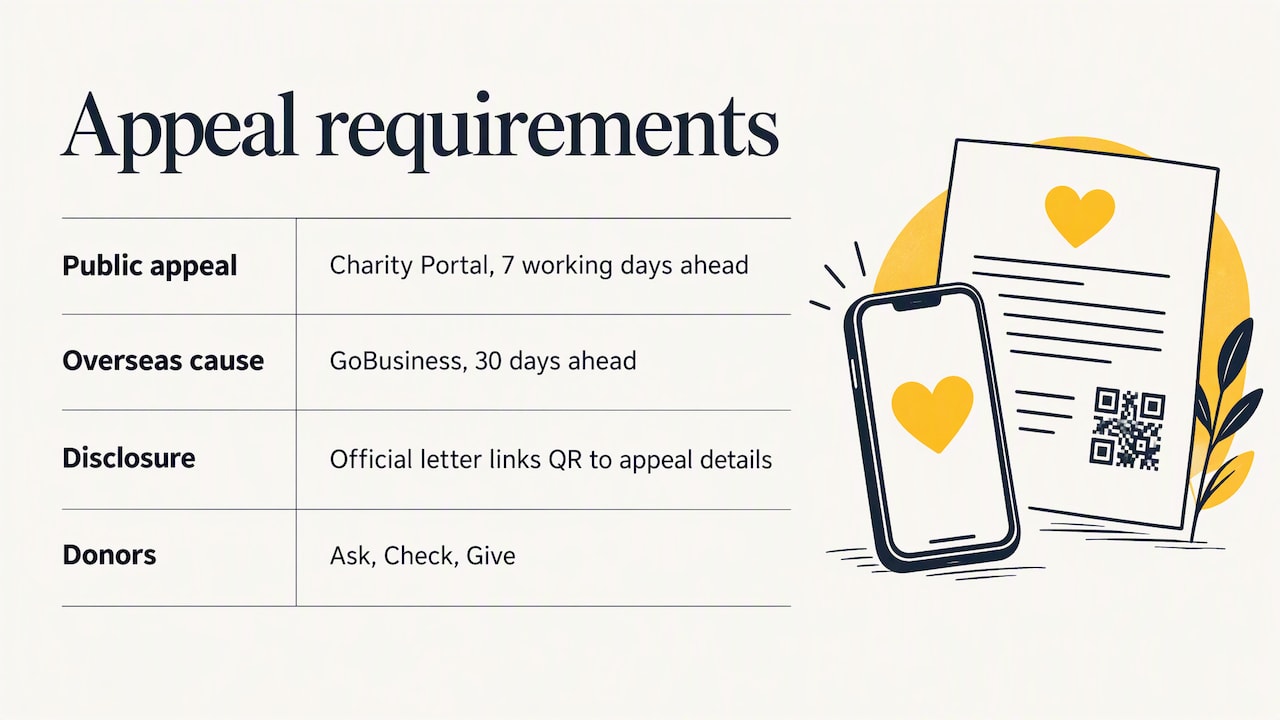
Since 9 October 2023, public appeals by registered and exempt charities, and by approved permit-holders, must be submitted through the Charity Portal at least seven working days before the appeal starts. This applies to collections of money or property by soliciting from house to house or in streets and other places. Selling shirts to your own members or through a closed sign-up form is different from soliciting the public, but if you are unsure which side your plan falls on, ask the charity you are helping or the Charities Unit before you launch.
If the money is for a cause overseas, the rules are stricter. A charity, commercial fund-raiser or commercial participator raising funds for a foreign charitable purpose must apply to the Commissioner via GoBusiness at least 30 days before the appeal begins. Build that lead time into your timeline.
For appeals that fall under the disclosure regime, the official letter from the charity or permit-holder carries a QR code linking to the appeal’s details on the Charity Portal. Donors are encouraged to Ask, Check, Give, so make your information easy to check.
Selling merchandise online
If you collect pre-orders through an online form, note that MoneySense says donation-based and reward-based arrangements that do not offer securities, such as donations or pre-payment for merchandise, are not subject to MAS regulations. That is the regulator’s view on securities only. It does not remove the charity fund-raising duties above.
GST
If a supporter gets goods in return for a payment, IRAS treats it as payment for a supply. Where the recipient gives direct benefits in goods or services, GST is accounted for at the prevailing rate on the open market value of the benefits. The same page notes that registered charities and IPCs need not account for GST on specified benefits treated as having no commercial value, when given in connection with a fund-raising event. Whether this affects you depends on whether you are GST-registered, so check with IRAS or your accountant.
Perspective: what we see go wrong, and right
We print for schools, companies, non-profits and event organisers, and the pattern is consistent. The campaigns that go smoothly decide the quantity from sign-ups, not hope. They approve one clean design early, instead of passing changes through five committee members. They also tell supporters exactly what each purchase does.
Our advice is to treat the shirt as a product first and a donation vehicle second. If people like wearing it, they wear it again, and your cause stays visible long after the event. Cutting cost by choosing a poor fabric usually backfires, because the shirt stays in the drawer. We would rather help you pick a good garment, a print method that suits your artwork and a quantity you can sell.
— Tommy
Get your fundraiser shirts printed
We handle the whole process for fundraiser orders: design and planning, printing and packing, and delivery to your school, office or venue. That means your volunteers spend their time selling, not chasing suppliers. Tell us your quantity, sizes, timeline and target amount, and we will advise on garment, print method and cost per shirt.
See examples of past work in our T-shirt printing portfolio, or read about our event T-shirt printing. When you are ready, request a quote from T-Shirt Printing Services.
How to promote the shirt and get people to buy
A good shirt does not sell itself. These steps work for most groups.
- Show a mock-up early. A clear image on a poster, chat group or email beats a description.
- Lead with the cause. Put the goal and the contribution per shirt in the first line.
- Set a short pre-order window. Two to three weeks is enough to create urgency without losing momentum. Give the deadline in every message.
- Use the people who already care. Teachers, class leaders, staff champions and committee members share more effectively than a general broadcast.
- Make it easy to pay and collect. One link, one pick-up point, and sizes chosen at order time.
- Wear it. Organisers and volunteers in the shirt on event day are the best advertisement for late buyers.
- Report back. Post the amount raised and thank buyers. It builds trust for next year.
Bundles help too: a family set, or a shirt with a cap, lifts the average order.
Checklist before you place the order
- Written agreement with the charity in place, if you are helping one
- Purpose and contribution per shirt written down and published
- Disclosure or permit requirements checked
- Quantity set from confirmed sign-ups, with a small buffer
- Final artwork approved in writing, including colours and print positions
- Size chart shared with buyers, with children’s sizes if relevant
- Delivery date confirmed with a buffer before the event
- One person owning payments and collection
If you are comparing printers, our list of things to consider before choosing a T-shirt printing company is a good starting point, and the complete custom printing guide goes through the order process end to end.
FAQ
How much can a T-shirt fundraiser raise?
It depends on the margin per shirt and how many you sell. Subtract your all-in cost per shirt from your selling price, multiply by shirts sold, then deduct other costs. Using confirmed pre-orders to estimate sales gives a far more reliable figure than guessing.
Do I need a permit to sell charity T-shirts in Singapore?
It depends on who is raising the funds and how. Public appeals by registered charities and permit-holders fall under a disclosure regime on the Charity Portal, and foreign causes need an application to the Commissioner of Charities. Check with the charity you are supporting or the Charities Unit before launching.
Is it better to pre-sell shirts or keep stock?
Pre-selling is safer because you print only what has been paid for. Keeping stock can raise more through walk-up sales at an event, but you risk leftover sizes. For most schools and small groups, pre-order with a small buffer is the better balance.
What should the shirt say?
Keep it short and tied to the cause: the name of the campaign, a single goal or message, and your logo. Avoid crowding the design, because simple, high-contrast artwork prints more cleanly and is more likely to be worn again.
Sources
- Cycle Home for Gladiolus Place
- Fund-Raisers Duties and Obligations, Charity Portal
- Fund-Raising for Local Charitable Purposes, Charity Portal
- Fund-Raising for Foreign Charitable Purposes, Charity Portal
- Safer Giving, Charity Portal
- Advisory on Fund-Raising for Foreign Charitable Causes
- Crowdfunding: What You Need To Know Before Investing, MoneySense
- Receiving Donation and Sponsorship, IRAS