Embroidered T-shirts suit small, simple logos on a sturdy fabric, such as a company crest on the chest of a staff tee or polo. They cost more per piece than printing and cannot reproduce photos, gradients or large artwork. For big graphics, full-colour designs or large school and event runs, printing is usually the better and cheaper route. This guide covers how to decide, what to brief, what drives the price and what to confirm before you order.
It is written for people buying for a group: a school teacher or CCA coordinator, an HR or operations manager, an events lead or a non-profit organiser.
TL;DR
- Choose embroidery for small chest logos, names and crests on thicker cotton or polo fabric. Choose printing for large, colourful or photographic artwork.
- Cost depends on stitch count, number of logo positions, quantity and garment. Ask whether a one-time digitising fee applies to a new logo.
- Confirm the logo file, thread colours, placement, sizes and a physical or digital proof before approving production.
- For uniforms washed often, check colour fastness, fabric weight and how the garment is cared for.
- We print rather than embroider, so we say plainly when printing is the better fit for your order.
Table of Contents
- What embroidery is, and what it is not
- When embroidered T-shirts are the right choice
- Fabrics and garments that suit embroidery
- Preparing your logo for embroidery
- What affects the price of embroidered uniforms
- Choosing uniforms that survive frequent washing
- Caring for embroidered shirts
- Timelines and what to confirm before you order
- Embroidery or printing: a quick decision guide
- Our perspective
- Printing for your team with us
- FAQ
- Sources
What embroidery is, and what it is not
Embroidery stitches thread directly into the fabric. A machine follows a stitch file made from your logo, building the design layer by layer. The result has texture and a slight sheen, and it looks like part of the garment rather than something sitting on top of it.
Printing is a different process. Ink, or a heat-applied transfer, sits on or in the surface of the fabric. We explain the main methods in our guide to screen printing, DTG and vinyl.
The difference matters in practice:
- Look: embroidery reads as premium and formal. Printing reads as flexible and expressive.
- Detail: embroidery handles bold shapes and lettering. It struggles with hairline strokes, tiny text and shading.
- Weight: thick stitching on a light, stretchy tee can pucker. Printing adds almost no weight.
- Cost curve: embroidery cost follows the number of stitches. Printing cost follows colours, size and method.
When embroidered T-shirts are the right choice
Embroidery earns its price in a few situations.
Front-of-house and client-facing staff. A small embroidered logo on a polo or tee gives a neat, durable finish for reception, retail, hospitality and service teams.
Garments that will be washed hundreds of times. Stitching does not crack or peel the way a poorly applied print can. If a uniform is worn several days a week, this is the main argument for it.
Names and roles. Embroidered names, initials or role titles on the chest or sleeve are common on uniforms, and they are small enough to stitch cleanly.
Caps, jackets and thick fabrics. Structured caps and heavier jackets take stitching well. Many windbreakers and varsity-style jackets carry a stitched crest for this reason.
It is a poor choice when your design is a large, multi-colour illustration, a photograph, or a gradient, or when you need 300 class tees by next month on a tight budget. That is printing territory. See our page on event T-shirt printing for how large runs are handled.
Fabrics and garments that suit embroidery
The garment decides whether embroidery looks sharp or cheap.
| Garment or fabric | Embroidery suitability | Notes |
|---|---|---|
| Cotton pique polo | Excellent | The standard uniform base; the textured weave holds stitches well |
| Heavy cotton tee (about 180 gsm and above) | Very good | Stays flat with a small logo |
| Lightweight or thin tee | Fair | Can pucker; may need a backing layer behind the stitching |
| Stretchy dri-fit or sports mesh | Limited | Holes and distortion are risks; printing is usually cleaner |
| Windbreakers and jackets | Good | Usually a crest or name on the chest or sleeve |
| Caps | Excellent | A classic use for stitched logos |
The gsm figures are a rule of thumb from common practice rather than a standard. Ask any supplier to stitch a sample on the exact garment you plan to buy. A sample on a different shirt tells you very little.
For sportswear, such as the dri-fit singlets and tees many CCAs and companies choose for activity days, printing is almost always the better match. Performance fabrics are made to stretch and breathe, and dense stitching works against both.
Preparing your logo for embroidery
A machine cannot stitch a JPEG. Your logo is converted into a stitch file in a step usually called digitising. How you brief it shapes the outcome.
Keep the design simple
Logos with two to four flat colours, thick lines and clear shapes stitch best. Gradients become banded blocks. Very small text under roughly 5 mm in height tends to fill in and become unreadable. If your crest has a motto in tiny type, either enlarge it, simplify it or move that detail to a print.
Send the right files
Send vector artwork if you have it (AI, EPS, SVG or a clean PDF) and a high-resolution PNG as a backup. Include any brand colour references so thread can be matched.
Decide size and placement
The usual positions are:
- Left chest, most common for logos
- Right chest or sleeve, often for a secondary mark or a name
- Back yoke or upper back, for a company name
- Cap front
A left-chest logo is typically a small mark, not a poster. Larger areas mean many more stitches and a higher price. Pick one primary position and add a second only if it earns its cost.
Choose thread colours deliberately
Thread colours come from a limited chart rather than unlimited ink mixing, so an exact Pantone match is not always possible. Dark thread on dark fabric disappears. Light thread on a white tee can look faint. Check contrast on the real garment colour, in daylight, not only on a screen.
For design guidance that applies to both stitching and printing, our tips for designing T-shirts that look great after production cover contrast, simplicity and file preparation.
What affects the price of embroidered uniforms
Because published prices vary a lot between suppliers and change often, treat any figure you read online as a starting point and ask for a written quote. These are the factors that move the number.
- Stitch count. A bigger or denser logo uses more stitches, takes longer on the machine and costs more.
- Quantity. Setup effort is spread across the run, so the unit price usually falls as the order grows. Many suppliers set a minimum order, so confirm it first.
- Digitising fee. A new logo normally needs to be converted into a stitch file. Ask whether this is a one-time charge and whether it is waived for repeat orders.
- Number of positions. Each additional placement (sleeve, back, cap) is priced separately.
- Garment. The shirt itself is often the largest part of the bill, particularly for quality polos.
- Thread colours. More colour changes mean more machine time.
- Extras. Individual names, folding and bagging by size, and delivery to several locations all add handling.
Ask for a quote that lists the garment price and the embroidery price separately, and states whether GST is included. That makes quotes from different suppliers comparable.
If you are comparing options on a fixed budget, a staff gift or uniform budget often has to cover several items. A guide to corporate gift budgets in Singapore can help you see how much of that budget a branded shirt should take.
Choosing uniforms that survive frequent washing
A uniform is judged by how it looks in month six, not on delivery day. A few checks help.
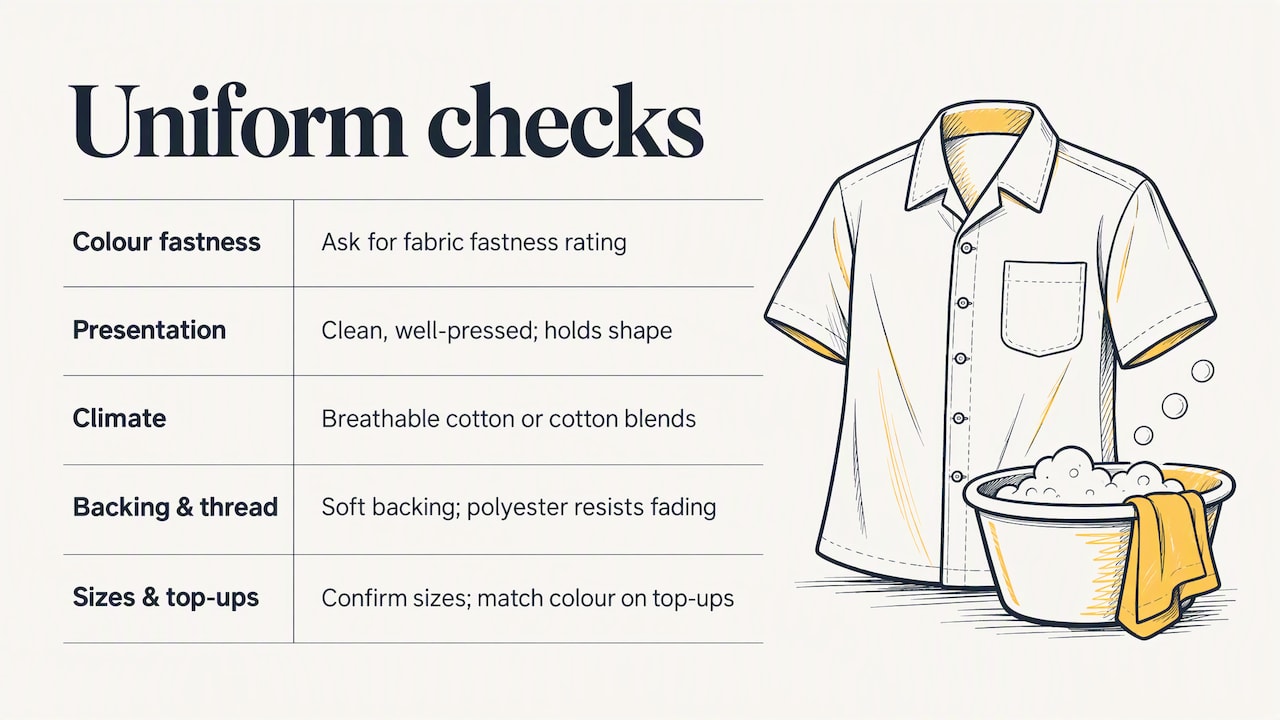
Colour fastness. Singapore’s National Environment Agency, in its uniform guide for the environmental services industry, says uniforms should use colour-fast textiles so they do not wash out easily. It also points to international test standards such as ISO 105-B02 as a reference. You can read this in the NEA guide on uniforms. It is written for one industry, but the principle holds for any team that wears the same shirt weekly: ask what the fabric’s fastness rating is.
Presentation. The same guide says uniforms represent both the company and its industry and should be clean and well pressed. A fabric that holds its shape and does not crease heavily helps staff meet that standard.
Climate. In Singapore’s heat and humidity, breathable cotton or cotton blends keep staff comfortable. Heavy, tightly stitched logos on thin synthetic cloth feel stiff against the skin, so check the inside of the sample as well as the front.
Backing and thread quality. The underside of the logo touches the wearer. Ask what backing is used and whether it is soft. Polyester thread generally resists fading better than cheaper alternatives, but ask the supplier what they use rather than assuming.
Sizing range. A uniform order covers many body types. Confirm the available sizes, and ask whether a small top-up order later will match the original colour.
Caring for embroidered shirts
General textile care applies. Gentle handling protects fibres, and heat and light are the usual enemies of fabric. The National Heritage Board’s collections care guide recommends simple housekeeping routines and careful storage away from heat and light for preserving textile garments. It is written for heritage collections, so use it as a principle rather than a washing manual.
For everyday uniforms, the garment’s care label is your first rule. As practical habits, many suppliers suggest:
- Turn the shirt inside out before washing to protect the stitching.
- Wash at a moderate temperature with a gentle cycle.
- Avoid ironing directly on the stitches; iron from the reverse or use a cloth.
- Hang to dry out of direct sun rather than using a hot dryer.
Pass a short care sheet to staff when you distribute uniforms. It costs nothing and extends the garment’s life.
Timelines and what to confirm before you order
Lead times vary by supplier, season and order size, so there is no single answer. Schools and companies tend to order at the same times of year, ahead of term starts, camps, annual dinners and National Day events, which can stretch queues. Ask for the turnaround counted from artwork approval, not from the first enquiry, and ask how long sampling takes if you want a physical stitch-out first.
Before you commit, confirm this list in writing:
- Garment brand, colour, fabric and size range
- Logo placement and stitched size in millimetres
- Thread colours, matched to your brand reference
- Digitising fee and whether it is one-time
- Minimum order quantity
- Proof method: digital mock-up, physical sample, or both
- Turnaround from approval and delivery date
- Delivery cost and location, including multiple drop-offs
- Policy if the finished goods differ from the approved sample
- Whether GST is included in the quote
Our article on what to consider before choosing a T-shirt printing company expands on the supplier checks that also apply to embroidery.
If something goes wrong
Keep the approved proof and the written quote. If goods differ materially from what was agreed and the supplier will not put it right, consumers can seek remedies under Singapore’s Consumer Protection (Fair Trading) Act. The Ministry of Trade and Industry describes the Act as providing civil remedies for aggrieved consumers, with a claim cap of $30,000 since 15 April 2009. The Act is aimed at consumers, so a company buying for business use should check its position with a lawyer or its own procurement team. A clear written agreement is the best protection in either case.
Embroidery or printing: a quick decision guide
| Your situation | Better fit |
|---|---|
| 300 class or CCA tees with a large design | Printing |
| Camp or event tees in bright colours | Printing |
| Dri-fit or sports singlets | Printing |
| Photographic or gradient artwork | Printing |
| Small chest logo on a front-of-house polo | Embroidery |
| Names or roles on staff shirts | Embroidery |
| Caps and structured jackets | Embroidery, or a stitched crest on a printed jacket |
| Tight deadline and tight budget on a large order | Printing |
Many teams combine both: printed tees for activities and an embroidered polo for formal days.
Our perspective
Most enquiries we receive from schools, companies and event organisers start with a word like “embroidery” because it sounds smart and lasting. When we look at the artwork and the headcount, the answer is often printing. A class of 40 students with a colourful house design, or 200 event staff in dri-fit, will get a sharper result and a lower cost per piece from printing.
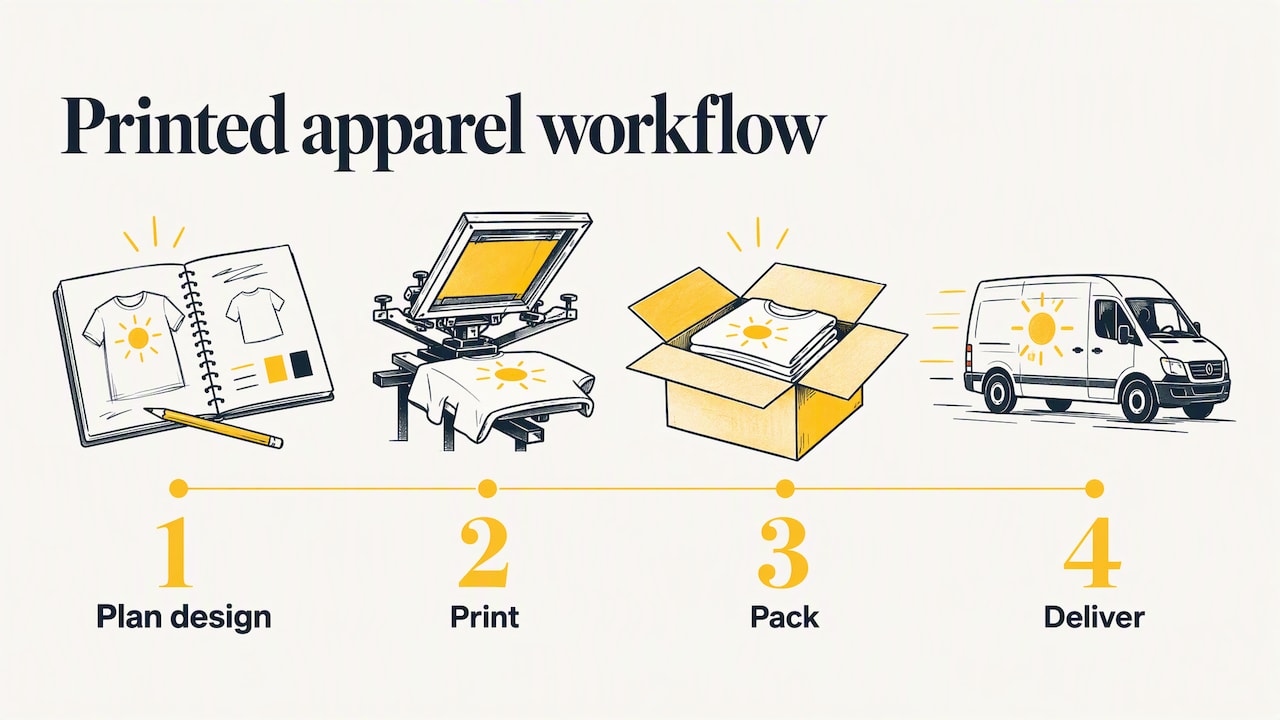
Our work is printing, design and delivery, and we are open about that. We handle the whole chain for printed apparel: planning the design, printing, packing and delivering, for T-shirts, sportswear, caps and attire, and university or polytechnic windbreaker jackets. Where embroidery is the right finish for a garment, we would rather tell you than push a method that does not suit it.
Three habits protect any order, whichever technique you pick. Approve a proof in writing. Decide who owns the artwork files before production starts. Order about 5 to 10 per cent extra in common sizes if new joiners are likely. Those small steps prevent most of the disputes we hear about.
— Tommy
Printing for your team with us
If your design is bold, colourful or large, or your order is a school, CCA, camp, event or company run, our printing service is built for it. We manage the design and planning, the printing and packing, and the delivery, so you deal with one team from artwork to doorstep.

See our company uniform shirt printing page for staff apparel, browse the printing portfolio for finished work, or start from our home page to request a quote.
FAQ
How many embroidered T-shirts do I need to order?
It depends on the supplier. Many set a minimum order, and the unit price usually falls as quantity rises. Ask each supplier for its minimum and for price breaks at two or three quantities, so you can see whether ordering a few more shirts lowers the cost per piece.
Can any logo be embroidered?
Most simple logos can, but fine lines, tiny text and gradients do not stitch well. A designer or digitiser may simplify the artwork, thicken thin strokes or reduce colours. Ask to see a proof of the stitched version before approving production.
Is embroidery better than printing for uniforms?
Not always. Embroidery suits small logos on polos and thicker fabrics, and it resists wear well. Printing suits large, colourful or photographic designs and stretchy sports fabrics, and it usually costs less on big orders. Many organisations use both for different garments.
How should I wash embroidered uniforms?
Follow the care label first. As good practice, turn the garment inside out, use a gentle cycle at moderate temperature, avoid a hot dryer and iron from the reverse side. Hang to dry away from strong sunlight.
What should I confirm before placing an order?
Get the garment, logo size and placement, thread colours, digitising fee, minimum quantity, proof method, turnaround from approval, delivery cost and GST treatment in writing. Keep the approved proof with the quote.
Sources
- Guide on Uniforms for Environmental Services Industry, National Environment Agency
- Your Collections: collections care guide, National Heritage Board
- Consumer Protection (Fair Trading) Act, Ministry of Trade and Industry
Recommended
- Custom Event Shirts in Singapore: A Planning Guide
- Custom T-Shirt Printing in Singapore: A Complete Guide for Businesses, Schools, and Events
- A Complete Guide to Choosing the Right T-Shirt Material for Printing in Singapore
- A Complete Guide to T-Shirt Printing in Singapore: Materials, Printing Methods, and Costs