Good logo printed shirts come down to five decisions: a clean logo file, the right placement and size, a print method that suits the artwork and the fabric, a proof you check carefully, and a supplier who handles the order from design to delivery. Get those right and a company, school or charity ends up with shirts that people actually wear. This guide walks through each decision for Singapore organisations ordering for a team, a class, a camp or an event.
TL;DR
- Send your logo as a vector file (AI, EPS, SVG or a print-ready PDF). A small, blurry JPEG is the most common reason a print looks soft.
- Left chest suits a small logo, the back or centre chest suits a large one. Decide placement before you pick the garment colour.
- Match the method to the artwork: solid colours, gradients and fine stitching-style detail each point to a different process.
- If the logo belongs to a company, school or association, confirm who has the right to use it before it goes on a shirt.
- Approve a proof, check sizes and quantities line by line, and keep the care label advice with the delivery.
Table of Contents
- What people mean by a logo printed shirt
- Prepare the logo file
- Placement and size
- Choose the print method for your logo
- Choosing shirts for a company, school or event
- Check you have the right to use the logo
- Cost, minimum quantity and timing
- Approve the proof properly
- Wash and care so the logo lasts
- Our perspective
- Order logo printed shirts with us
- FAQ
- Sources
What people mean by a logo printed shirt
The phrase covers several products. A company logo shirt is usually a polo or round-neck tee with a small crest on the chest for staff, roadshows or a client event. A school or CCA shirt carries a crest, a class name and often a number or nickname on the back. An event shirt can have a large graphic across the front and sponsor marks on the sleeve or back.
The common thread is a logo that has to be reproduced faithfully, in the right colours, in the same place on every shirt. That is a different job from printing a one-off design for fun, and it is the job we do for schools, businesses, non-profits and event organisers.
Before you contact any printer, collect these four things:
- The final logo file in its original format.
- The brand colours, ideally as Pantone references or hex codes.
- A headcount with sizes, or at least a size split you can defend.
- The date the shirts must be in hand, not the date you place the order.
Prepare the logo file
The file decides how sharp the result is. A printer can only reproduce the detail that exists in the artwork.
Vector or raster
A vector file (AI, EPS, SVG, or a PDF saved from vector artwork) holds shapes and curves, so it can be enlarged for a back print and reduced for a left-chest mark without losing sharpness. A raster file (JPEG, PNG) holds pixels. If the pixels are too few for the size you want, edges turn fuzzy.
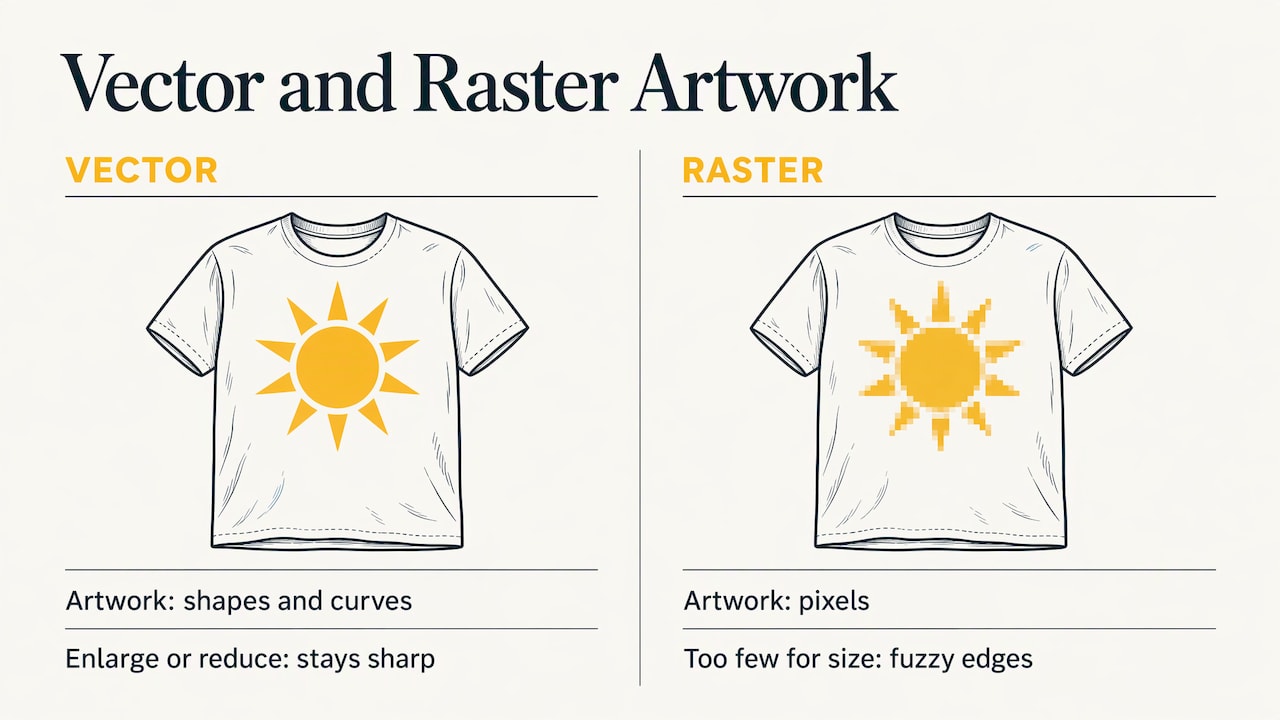
If you only have a raster logo, ask whoever made it, whether that is a design agency, the school communications office or your marketing team, for the original vector. If none exists, a designer can redraw it, and our design and planning service can help you get the artwork print-ready. Our guide on designing shirts that look good after printing is written for people who are not designers.
Colours and detail
Screens and fabric do not show colour the same way. Give exact colour references for brand colours, and say which garment colour you plan to use. A navy logo that looks crisp on a white tee can disappear on a charcoal one. If your logo is navy, you may need a white outline or a light-coloured version for dark garments. Very thin lines and tiny text also need thought: lettering that reads well on a letterhead can clog up when it is shrunk to a few centimetres.
Keep a one-colour version
Most brand kits include a single-colour version of the logo. It is useful on shirts because it often costs less to produce, works on more garment colours and suits large quantities. Ask for it before you finalise the design.
Placement and size
Placement is where a logo shirt looks professional or amateur. One widely used guide describes left chest as a popular spot for small logos, usually about three to four inches below the collar and kept clear of the armpit area, with example sizes from 2.5 by 2.5 inches up to 5 by 5 inches. Those are starting points, not rules. Children’s sizes, women’s cuts and long logos all need adjusting.
A simple way to think about it:
| Placement | Typical use | What to watch |
|---|---|---|
| Left chest | Staff polos, uniforms, quiet branding | Keep the logo proportionate across sizes, so it does not look huge on XS or tiny on XXL |
| Centre chest | Event tees, campaign shirts | Sit it below the collar line so it does not look pulled up |
| Full front | Statement designs, class shirts | Large solid areas change how the shirt feels, so consider the method |
| Back | Team names, sponsor lists, class numbers | Leave room under the collar and keep the text readable from a distance |
| Sleeve | Secondary marks, sponsor logos | Small area, so keep the artwork simple |
For groups, ask for one mock-up with the artwork placed on a shirt outline in the actual garment colour. It shows problems before production does. Our portfolio gives an idea of how different placements look on finished work.
Choose the print method for your logo
There is no single best method. The right one depends on the artwork, the garment, the quantity and how the shirt will be used. We explain the options in more depth in our guide to choosing the right printing method and in the one on materials, methods and costs. In outline:
| Logo type | Methods usually considered | Why |
|---|---|---|
| One or two flat colours, large quantity | Screen printing | Solid, durable colour, and setup is spread across many shirts |
| Many colours, gradients or photos | Digital methods such as DTF or DTG | Handles colour detail without a separate screen for each colour |
| Crest on a polo or jacket | Embroidery | Stitched texture looks formal on thicker fabrics |
| Small quantity or names and numbers | Heat transfer or digital | Practical when each shirt differs |
Three questions narrow the choice quickly:
- How many colours does the logo have? Flat colours point to screen printing. Gradients and shading point to digital.
- What is the fabric? Cotton, performance polyester and nylon jackets do not all take the same process. Sportswear in particular needs a method that stays flexible and breathable.
- Is it for a one-day event or daily wear? A shirt worn once at a carnival has different needs from a staff uniform washed every week.
If you are ordering polos or windbreakers for staff, students or committee members, embroidery or a small chest print is often the tidy choice. Our pages on university and polytechnic windbreaker jackets cover that side of the range.
Choosing shirts for a company, school or event
The decisions differ by group, so start with who wears the shirt and when.
Businesses
Staff uniforms need consistency: the same garment, the same logo position and the same colours on reorders months later. Keep the artwork file, the colour references and the garment style on record. Our overview of why custom printing remains a popular branding choice explains the visibility benefit, and the page on corporate T-shirt printing covers team building, events and promotions.
Company logo shirts also earn their keep at activities. If you are planning a team day, a matching shirt makes groups easy to spot, and activities such as outdoor corporate team-building sessions are a natural fit for shirts with the company logo on the chest and a team name on the back.
Schools and CCAs
For classes, camps and CCAs, the practical issues are sizing across a wide age range, parent collection or delivery to the school, and a design the students like. Collect sizes early with a form, and add a small buffer for late joiners if the budget allows. We have written specifically about school, CCA and camp orders and school camp shirts for teachers and organisers.
Non-profits
Volunteers need to be recognisable at a glance. A bold, readable front or back print matters more than fine detail, and a lighter, breathable garment suits outdoor drives. Think about the shirt as part of the fundraising story: a logo plus a short campaign line can make the shirt worth wearing after the event.
Event organisers
Event shirts usually need several versions: organiser, volunteer, speaker, sponsor. Plan these as a set with a clear colour or label system so staff do not mix them up on the day. Our event T-shirt printing page and event shirt planning guide go through this in more detail.
Check you have the right to use the logo
Before a logo goes on shirts, confirm who owns it and who can approve its use. For your own company’s logo, this is usually straightforward. It gets less clear in three situations:
- A logo made by a freelancer or agency. Check your agreement covers use on merchandise.
- A school, institution or association logo. The communications office, the principal or the committee typically approves use. Get that approval in writing and keep it with the order.
- A third-party or sponsor logo. Ask the sponsor for its approved artwork and any usage rules.
In Singapore, a registered trade mark gives its owner exclusive rights over the mark. The Intellectual Property Office of Singapore explains that a trade mark can be letters, words, devices or combinations, and a registration lasts 10 years from filing before it can be renewed. In practice, that means you should not put a brand’s logo on shirts without the owner’s consent. If you are unsure whether a mark is protected, speak to the owner, or to an intellectual property lawyer for a formal view.
Cost, minimum quantity and timing
We do not publish fixed prices because the price of an order depends on the details. The factors that move a quote are the same across the industry:
- Quantity. Setup work is spread over more shirts, so per-shirt cost usually falls as the order grows.
- Method. Screen printing, digital printing and embroidery are priced differently.
- Garment. A basic cotton tee, a performance fabric and a polo sit at different points.
- Artwork. The number of colours, the number of print positions and any artwork clean-up all count.
- Timeline. A tight deadline can limit method options.
To get a quote you can compare, send the same brief to each supplier: quantity, size split, garment type, print positions, colour references and the in-hand date. Ask what is included, for example artwork set-up, packing and delivery, so that the quotes are like for like. For the process in order, see from design to delivery.
Work backwards from your event date. Allow time for artwork, proof approval, production, packing and delivery, plus a buffer. Orders for school camps and company dinners tend to cluster around the same periods each year, so ordering early gives you more choice.
Approve the proof properly
The proof is your last cheap chance to fix an error. Treat it as a checklist rather than a glance.
- Spelling. Read every name, title and class label aloud. Ask a second person to do it too.
- Logo version. Confirm it is the current logo, not an old one.
- Colour. Check the references against your brand guide. Remember a screen is only a guide to how ink or thread will look on fabric.
- Placement and size. Check the distance from the collar and the width against the garment.
- Garment. Confirm the style, colour and size split.
- Quantities. Match the total to the list you collected.
Once production is done, check a sample from the batch on arrival: print edges, stitching cleanliness, alignment and garment condition. Report any issue straight away with photos so it can be resolved.
Wash and care so the logo lasts
Care matters because the logo is what people notice first. For digitally printed and heat-transfer shirts, one care guide recommends hand washing or a delicate cycle in cool or lukewarm water, washing inside out, avoiding bleach and drying in the air or on low heat. If ironing is needed, iron inside out or cover the design with a protective layer rather than pressing hot iron directly on it.
For group orders, include a short care note with the delivery, or add it to the group chat, so each person gets the same advice. Dark and bright colours also last better when washed separately from other items.
Our perspective
Most problems with logo shirts are not printing problems. They start earlier: a logo file that is too small, a size list that was never checked, or approval that came from one person when three needed to see it.
We think the best result comes from handling the whole job in one place, from design and planning to printing, packing and delivery. When one team looks after artwork, production and delivery, nothing gets lost in a handover, and the shirt that arrives matches what you approved.
That is why we focus on advanced printing technology and full customisation of design, material and delivery. A school class and a corporate team do not need the same shirt, and we would rather fit the shirt to the group than the other way round.
Send us the logo, the headcount and the date. We will help you work out the placement, the method and the garment, and show you what it will look like before it is made.
Tommy
Order logo printed shirts with us
We print and produce custom T-shirts, school class, camp and CCA shirts, event and conference shirts, sports caps and attire, and university and polytechnic windbreaker jackets. We also handle design and planning, printing and packing, and delivery, so one team looks after the order from first brief to the box at your door.

To start, send us your logo and what you need on the T-shirt printing page. We do not publish prices, so we quote each order on its details.
FAQ
What file format should I send for logo printing?
A vector file such as AI, EPS, SVG or a print-ready PDF is best, because it can be scaled to any size without losing sharpness. If you only have a JPEG or PNG, send the largest version you have and tell us where the logo will sit. We can advise whether it is usable or needs redrawing.
Where should the logo go on a company shirt?
Left chest is the usual choice for a small company logo on a polo or tee. Guides typically place it a few inches below the collar and clear of the armpit, with the exact size depending on the garment and the logo shape. A larger logo or team name often goes centre chest or on the back.
Can I print my school’s or another organisation’s logo on shirts?
Only with the permission of whoever owns it and approves its use. For a school or association, that is usually the office or committee in charge of its branding, and it helps to have the approval in writing. A registered trade mark gives its owner exclusive rights, so do not use a third party’s logo without its consent.
Which printing method is best for a logo with many colours?
Digital methods such as DTF or DTG usually handle many colours, gradients and fine detail well. Screen printing suits logos with one or two flat colours in larger quantities, and embroidery suits crests on polos and jackets. Tell us your garment and quantity and we will recommend one.
How do I keep a printed logo looking good after washing?
Turn the shirt inside out, wash in cool water on a gentle setting, avoid bleach and let it air dry or use low heat. Iron inside out or cover the design first. Follow the care label on the garment as well.