Photo T-shirt printing puts a photograph, full colour and often with fine detail, onto a shirt. For a clean result you need a sharp original image, a printing method suited to photos (usually digital transfer or direct-to-garment), a light or mid-tone shirt in a smooth fabric, and a proof you approve before the full run. If the photo includes a logo, a landmark symbol or someone else’s work, check the permissions first. This guide covers each step for schools, businesses, non-profits and event organisers ordering in groups.
TL;DR
- Photos need a printing method that handles gradients and many colours. DTF (direct-to-film) and DTG (direct-to-garment) are the usual choices, and screen printing suits simple, flat-colour artwork.
- The sharpness of your original decides the result. Send the largest, original file, not a screenshot or a chat-app copy.
- Always approve a digital proof, and ask for a sample when colour accuracy matters, such as for a group photo or a brand colour.
- Check ownership before you print: photographers hold copyright by default, and Singapore bodies set rules on the Merlion Symbol and on currency images.
- We handle design, printing, packing and delivery for group orders, so you deal with one team from file to doorstep.
Table of Contents
- How photo printing on a T-shirt works
- Preparing your photo so it prints sharply
- Choosing fabric, colour and placement
- Proofs, samples and colour accuracy
- What affects cost, minimum order and turnaround
- Check the rights before you print a photo
- Caring for photo-printed shirts
- Perspective
- Order photo shirts for your group
- FAQ
- Sources
How photo printing on a T-shirt works
A photograph is made of thousands of colours and soft tonal changes. A logo is usually a handful of flat colours. That difference decides which printing method works.
The method most often used for full-colour images today is DTF. In DTF, liquid ink is printed onto a specialised heat-transfer film, and a heat press then activates the film’s adhesive to bond the design to the shirt, on light or dark garments. Because the image is printed on film first, the printer can reproduce fine detail and gradients, then press the same transfer onto many shirts for consistent results.
Other routes exist, and each has a sensible use:
| Method | Best for | Watch out for |
|---|---|---|
| DTF (film transfer) | Full-colour photos, small to medium group orders, light and dark shirts | Very large prints can feel less breathable than a thin ink layer |
| DTG (direct-to-garment) | Detailed photos on light cotton shirts, small runs | Results depend on fabric and colour of the shirt |
| Screen printing | Simple, bold artwork in few colours, large runs | Not suited to photographic gradients unless the photo is converted to a simplified graphic |
| Heat-transfer vinyl | Names, numbers, one-colour shapes | Not meant for photographs |
If you are not sure which applies to your artwork, send it to us and we will recommend one. Our guide on materials, printing methods and costs explains the trade-offs in more depth.
Preparing your photo so it prints sharply
Most disappointing photo shirts fail before the printer is switched on. The cause is almost always the file.
Clear communication about file specifications upfront prevents costly revisions and production delays, so settle the details with your printer before you finalise the image.
Start with the original
- Use the file straight from the camera or phone, not a copy sent through a messaging app, which is usually compressed and smaller.
- Avoid screenshots and images saved from social media. They are small and often show compression marks that become obvious when enlarged.
- If the picture looks soft when you zoom in on your screen to the size you plan to print, it will look soft on the shirt.
Agree the file format and size with your printer
Printers differ on what they prefer. Many ask for a high-resolution PNG or a layered design file at the actual print size, and a transparent background if the photo is cut out. Ask for the exact minimum resolution and accepted formats before you send anything, and do not enlarge a small image to make it fit, because enlarging adds pixels but no detail.
Simplify what the shirt cannot show
- Busy backgrounds. A group photo with a cluttered background often looks better cut out, or faded at the edges so it blends into the fabric.
- Dark photos on dark shirts. Shadows can disappear. Brighten the image slightly or place it on a lighter shirt.
- Fine text in the photo. Small lettering, such as a banner in the background, may become unreadable. Crop it out or add the text separately as clean type.
- Faces. Faces are the first thing viewers judge. Keep them large enough in the print area, and avoid placing a seam, pocket or zip across them.
For non-designers, our tips on designing shirts that look great after printing walk through layout choices in plain language.
Choosing fabric, colour and placement
Photos are sensitive to the surface they sit on. A few practical rules hold across methods:
- Smooth, tightly knitted fabric gives a cleaner image than a textured or loosely knitted one, because the surface is more even.
- White and light shirts show true colour most faithfully. On dark shirts, a printer can lay down a white base first, which changes the feel of the print, so ask how your printer handles it.
- Placement matters. A centre-chest print up to a large front panel suits portraits and group photos. A small left-chest photo rarely reads well. Back prints suit team photos with a name list.
- Blends and polyester can behave differently with heat and ink. For sportswear, ask which method is safe for the fabric you picked.
If you are choosing between a T-shirt, sportswear or a jacket for the same photo, tell us the garment first. Our range includes sports attire and university and polytechnic windbreaker jackets, and a photo that works on a tee may need resizing for a jacket back.
Proofs, samples and colour accuracy
Screens glow and fabric does not, so a photo never looks identical on both. Close is the goal, and you reach it by checking before the full run.
- Ask for a digital mock-up. It shows size, position and cropping on the garment.
- Check the proof on a good screen. Zoom in on faces and edges. Check names and spellings, which are the most common last-minute errors for CCA, class and event shirts.
- Request a physical sample when colour matters. This is worth it for group photos, brand colours or an order of a few hundred pieces.
- Approve in writing. A clear sign-off protects both sides. Production begins from the approved version.
- Send your corrections together. One consolidated list avoids rounds of small revisions that slow the schedule.
The full sequence from artwork to doorstep is set out in our article on the step-by-step process of T-shirt printing in Singapore.
What affects cost, minimum order and turnaround
We do not publish a fixed price list, because photo shirts vary too much for a single figure to be honest. These are the factors that move a quote:
- Quantity. Group orders spread setup work across more pieces. Say how many you need, and in which sizes.
- Print size and number of placements. A front and back photo costs more than a front only.
- Method. A film transfer, direct print and screen print are priced differently.
- Garment type and quality. A basic tee, a performance fabric and a jacket are not comparable.
- Artwork readiness. Files that need retouching, cut-outs or layout work add design time.
- Deadline and delivery. Tight schedules and multiple delivery points need planning.
To get a quote that you can compare fairly, send the same brief to each printer you consider: quantity, size range, garment, number of print placements, file or photo, delivery address and the date you need them. Our checklist of things to consider before choosing a printing company lists what else to ask.
Working back from the event date also helps. Count time for artwork, proofing, any sample, production and delivery, then add a buffer for changes in headcount or sizes.
Check the rights before you print a photo
A photo on a shirt is a reproduction, and some images carry rules. This is where group orders by schools, companies and non-profits most often slip.
Who owns the photo
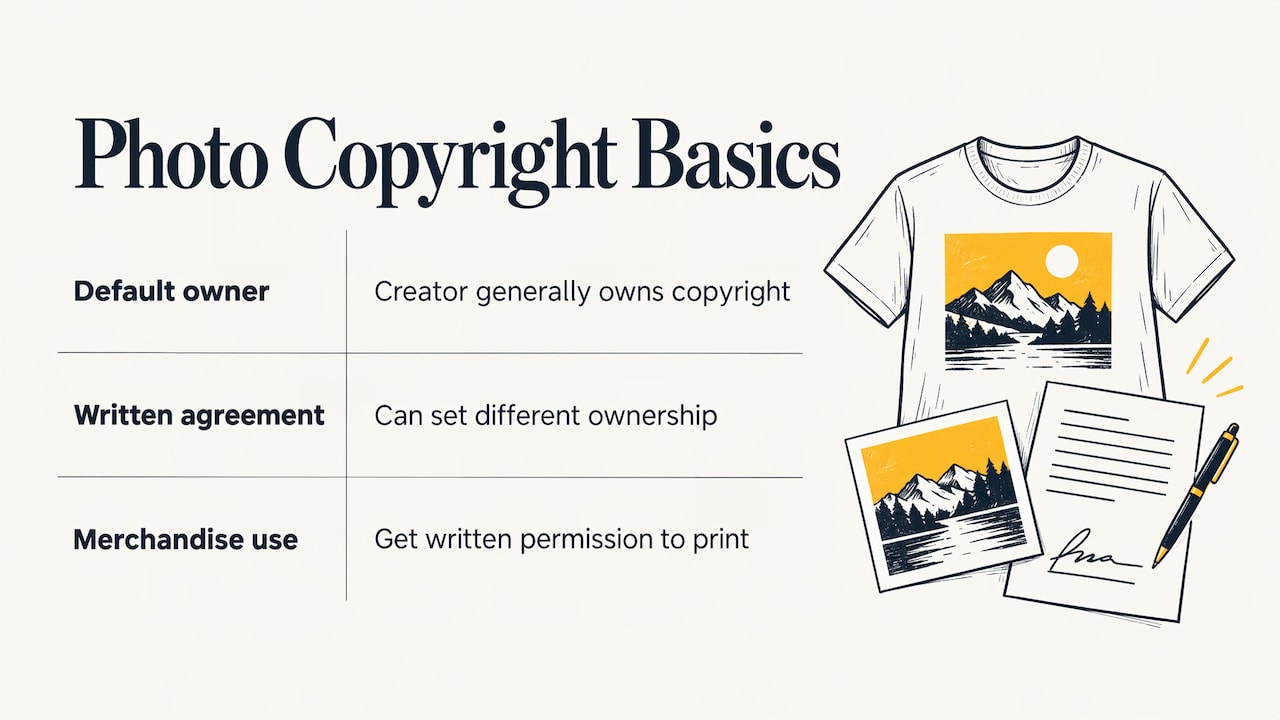
Under Singapore’s copyright framework, content creators are generally the default copyright owners, but parties can agree otherwise in writing. Businesses that want to own copyright when they are not the default owner need a written agreement with the creator. In practice: if a photographer took the team or event photo, get written permission to print it on merchandise, especially if the shirts will be sold.
The Merlion and other tourism symbols
The Singapore Tourism Board says users may apply for permission to use the Merlion Symbol or anything resembling it, and some uses do not need an application. It sets out conditions and an application process on its brand assets page. If your shirt design features the Merlion, read that page before you finalise artwork.
Currency images
If your design includes a Singapore banknote or coin, the Monetary Authority of Singapore requires permission to import, manufacture, sell, circulate or distribute merchandise carrying a reproduction of currency, subject to stated exceptions. Check MAS guidance on using images of Singapore currency before printing a fundraising or novelty design.
Photos of people
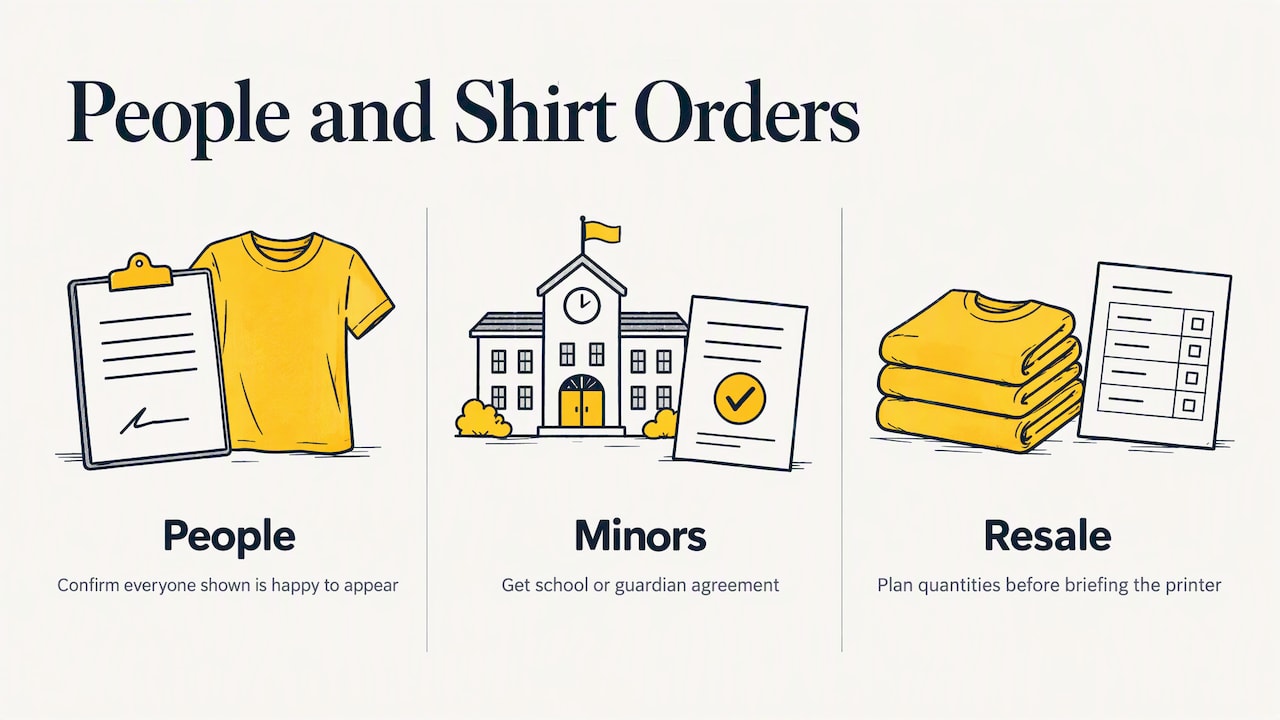
For shirts featuring students, staff or volunteers, confirm that everyone shown is happy to appear, and for minors, that the school or guardians have agreed. This is a good-practice step for any organisation, and your printer will ask who approved the artwork.
If your CCA, club or class plans to resell shirts to members, a team merchandise platform for clubs shows how groups handle ordering and payments, so you can plan quantities before you brief the printer.
Caring for photo-printed shirts
A good print lasts longer with sensible care. Check the care label and any instruction your printer gives, since they depend on method and fabric. As general habits for printed garments:
- Turn the shirt inside out before washing.
- Use a gentle cycle and avoid harsh scrubbing over the print.
- Let it air dry where you can, rather than using high heat.
- Do not iron directly on the print. Iron from the reverse side.
For school and event shirts that will be worn often, tell your printer how the shirts will be used. Sports use, for example, may call for a different method or fabric than a one-day event tee.
Perspective
Photo shirts reward preparation. In our experience, the orders that go smoothly share three traits: a sharp original file, one person who approves the proof, and a delivery date set with room to spare. We built our service around managing the whole chain, from design and planning through printing, packing and delivery, because group orders rarely fail at the press. They fail in the gaps between file, approval and handover.
That is why we put design support and proofing up front. Schools, businesses and non-profits usually need many sizes, a clear look and a dependable schedule, not a lecture on printing technology. We use advanced printing technology and full customisation of design, material and delivery to fit that brief, so the shirt reflects the group that wears it.
If you have a photo and an idea, send both. We will tell you what will print well, what to adjust, and what to leave out.
Tommy
Order photo shirts for your group
We print for schools, CCAs and camps, companies, events and non-profits, with design and planning, printing and packing, and delivery handled together. Share your photo, quantity and deadline, and we will advise on method, garment and placement. You can see finished work in our T-shirt printing portfolio.

For event orders, see our page on event T-shirt printing in Singapore, or start from our main page to request a quote.
FAQ
What is the best method for printing a photo on a T-shirt?
For full-colour photos, DTF and DTG are the usual choices, because they reproduce gradients and fine detail. DTF presses a printed film onto the shirt with heat, and works on light or dark fabric. Screen printing suits simple artwork in a few flat colours.
Can I print a photo I found online?
Only if you have the right to use it. Photographers and creators are generally the default copyright owners in Singapore, so you need their permission, ideally in writing, before printing the image on shirts. A low-resolution web image will also print poorly.
How can I be sure the colours will look right?
Approve a digital proof, and ask for a physical sample when colour accuracy matters. Screens and fabric never match exactly, so a sample on the actual garment is the surest check before a large run.
Do you print one shirt only?
Our service is built for group orders from schools, businesses, events and non-profits. Tell us your quantity and we will advise on what suits your project.
Sources
- How To Put a Picture on a Shirt: 4 Ways To Print Shirts (Shopify Singapore)
- Printed Short Sleeve T-Shirts: Complete Customization Guide (Alibaba.com Seller Blog)
- Factsheet for businesses on the Copyright Act 2021 (IPOS)
- STB Brand Assets (Singapore Tourism Board)
- Using Images of Singapore Currency (MAS)
Recommended
- Custom T-Shirt Printing in Singapore: Everything You Need to Know Before Ordering
- A Complete Guide to T-Shirt Printing in Singapore: Materials, Printing Methods, and Costs
- From Design to Delivery: The Step-by-Step Process of T-Shirt Printing in Singapore
- Custom T-Shirt Printing in Singapore: A Complete Guide for Businesses, Schools, and Events