Embroidered polo shirts are the safest choice when a school, company, non-profit or event team needs a smart uniform that survives repeated washing. The logo is stitched into the fabric rather than laid on top, so it keeps its shape and looks premium. It works best with simple, bold artwork on a left-chest or sleeve position. We manage the whole order from design to delivery, so you do not have to sort out files, sizes and packing yourself.
This guide is for people ordering in bulk: a teacher choosing staff polos, an HR or operations lead ordering for a team, a volunteer coordinator or an event organiser. It explains what embroidery is, how to prepare your logo, which fabrics and placements work, how embroidery compares with printing, and what moves the price.
TL;DR
- Embroidery stitches your logo into the polo with thread. It suits uniforms, staff wear and anything washed often.
- Send your logo as a vector file (AI, EPS or vector PDF). Keep it simple: solid colours, clear shapes, no gradients or fine detail.
- Left chest is the classic position. Cotton piqué polos are the traditional base for embroidery.
- Printing is better for large, colourful or photographic artwork. Embroidery is better for crests, wordmarks and names.
- Cost depends on quantity, logo size and detail, number of colours and where you place the logo. Ask for a quote on your actual artwork.
Table of Contents
- What polo shirt embroidery involves
- Why embroidery suits polo shirts
- Preparing your logo for embroidery
- Fabric, placement and size
- Embroidery or printing: which is right for your polos?
- What affects the cost of embroidered polos
- A simple ordering routine
- Who orders embroidered polos in Singapore
- Mistakes to avoid
- Our approach to polos for teams
- Ready to order polos for your team?
- FAQ
- Sources
What polo shirt embroidery involves
Machine embroidery uses a computer-controlled machine that sews a design into fabric with thread. Machine embroidery needs a stitch file, which is made by converting your artwork into instructions for the machine: where each stitch goes, in what direction and in which colour. This conversion is called digitising.
The process, in plain terms:
- Artwork is digitised. A person turns your logo into a stitch file. The file is created once for a given size and can be reused for repeat orders.
- The polo is hooped. The garment is held tight in a frame, with a backing layer (stabiliser) underneath so the knit does not stretch or pucker.
- The machine stitches each colour in turn. Each thread colour is sewn in sequence, then trimmed.
- The finished polo is checked, trimmed and packed.
The result is a raised, textured logo with a slight sheen from the thread. That texture is what people mean when they call an embroidered polo “premium”.
Why embroidery suits polo shirts
A polo shirt has a collar and a short buttoned placket, and is usually made from knitted cotton or a cotton blend. It sits between a T-shirt and a dress shirt, which is why it is the default for front-of-house staff, sales teams, teachers, school staff, coaches and event crew.
Embroidery matches that role for three reasons:
- Appearance. A stitched crest on a collared shirt looks formal without being stiff. It reads as a uniform, not as merchandise.
- Durability. Thread is part of the garment. It does not crack, peel or fade the way some surface prints can after many washes. This matters in Singapore, where staff and students sweat in the heat and uniforms are washed often.
- Consistency. Once the stitch file is set, every polo in the order carries the same logo, in the same place, at the same size. That is hard to beat when you are dressing 40 staff or 400 students.
If your group wears the shirt every week for a year or more, embroidery is usually the first method to consider. For a one-off event shirt that will be worn twice, printing is often the better fit, and our guide to choosing a printing method covers the trade-offs.
Preparing your logo for embroidery
This is where most orders go right or wrong. Embroidery is stitched thread, not ink, so it cannot reproduce everything a printed logo can.
The file to send
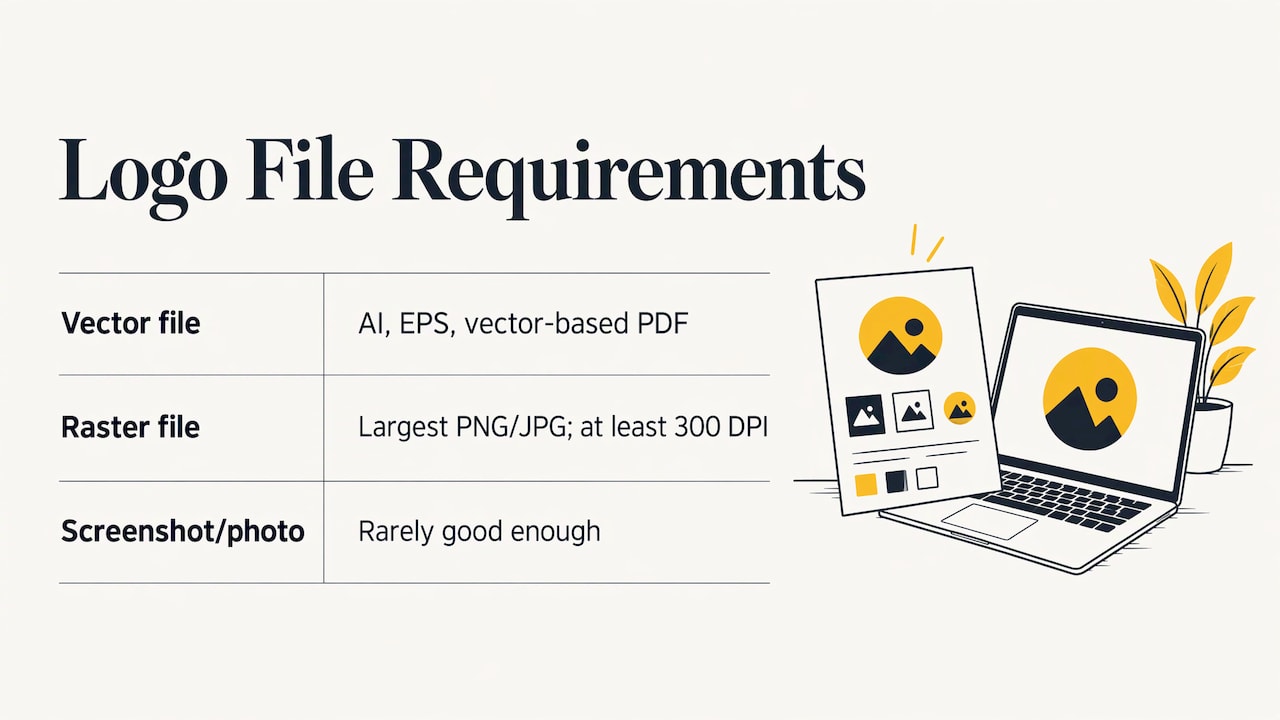
The best source is a vector file: AI, EPS or a vector-based PDF. A vector file is built from lines and shapes, so it can be enlarged or reduced without going blurry, and it gives the digitiser clean edges to follow. If you only have a PNG or JPG, send the largest version you have. Digitising guides commonly recommend at least 300 DPI for raster files, and note that vector formats such as AI and EPS are the preferred source.
A screenshot from a website or a photo of a logo on a wall is rarely good enough. If you do not have the original, tell us who made the logo or where it was used, and we can help you work out what to supply.
What the design should look like
Good embroidery artwork has:
- Solid, clearly separated colours. Thread colours do not blend. A gradient becomes a few stripes of colour, and a drop shadow becomes a muddy outline.
- Bold shapes and readable lettering. Very thin lines and tiny text can disappear into the weave of the fabric.
- A limited number of colours. Each extra colour means another thread change, which adds time and cost.
- A known final size. Decide the width before digitising. Digitising guides explain that a stitch file is a set of machine instructions, not editable artwork, and that resizing it changes the stitch density, so a very different size normally needs a fresh digitising job.
School crests with fine shading, a company logo with a small tagline underneath, or a photo-style mascot are the usual problem cases. The fix is almost always a simplified version for stitching: keep the shape and colours, drop the tiny detail. Our design tips for non-designers show how to simplify artwork so it works on fabric.
A quick artwork checklist
| Check | Embroidery-ready | Needs simplifying |
|---|---|---|
| File type | AI, EPS or vector PDF | Small PNG, JPG or screenshot |
| Colours | Flat, 1 to 4 colours | Gradients, glows, shadows |
| Text | Bold, clear letters | Thin or very small text |
| Detail | Simple shapes | Fine lines, textures, photos |
| Size | Final width decided | “Make it fit” |
Fabric, placement and size
Choosing the polo fabric
Two fabric families cover almost every team order:
- Cotton or cotton-blend piqué. Piqué is a knit with a small raised texture. It is the traditional polo fabric, takes embroidery well and looks smart for offices, schools and hospitality. Because the surface is textured, very fine stitching can sink into it, which is another reason to keep artwork bold.
- Dri-fit or performance polyester. Lightweight and moisture-wicking, popular for sports teams, outdoor events and anyone on their feet in the heat. It can be embroidered, but a very dense logo can make a light fabric feel stiff or pucker, so a lighter design is better here. Our article on custom printing on dri-fit and polo shirts explains why teams choose each.
Pick the fabric first, then finalise the logo, so the digitiser can adjust the stitching to suit the knit.
Where to put the logo
| Position | Best for | Notes |
|---|---|---|
| Left chest | Almost every uniform | The classic. Keep clear of the placket and buttons |
| Right chest | Name, role or secondary logo | Pairs well with a left-chest crest |
| Sleeve | Sponsor, department or house marks | Small, simple marks only |
| Back, below the collar | Event or team name | Small embroidery works; very large artwork is better printed |
| Collar | Subtle brand mark | Small and simple |
A left-chest logo is commonly sized somewhere around 3 to 4 inches (roughly 8 to 10 cm) wide on an adult polo, with smaller sizes and children’s polos usually carrying a slightly smaller version. Treat that as a starting point. A long wordmark may need a different shape from a round crest, and your polo’s cut and the logo’s proportions decide the final size.
Names and numbers
Personalisation, such as a staff name or a class and year, is a common add-on. Names are stitched as lettering, so they need legible fonts and a minimum size. Decide early whether you want names, as it changes how the order is organised: each polo has a different name, so the size list and name list must match exactly.
Embroidery or printing: which is right for your polos?
Both methods work on polos. The better question is what the shirt is for.
| Factor | Embroidery | Printing (screen, DTF, heat transfer) |
|---|---|---|
| Look | Raised, textured, premium | Flat, can show full colour and fine detail |
| Best artwork | Simple logos, crests, wordmarks, names | Large, colourful, gradient or photo-style artwork |
| Durability | Very high | Good, depends on the method and care |
| Feel | Slight stiffness behind the logo | Soft, especially with thin transfers |
| Large logos | Heavy and costly | Practical |
| Cost drivers | Logo size and detail | Number of colours, method and quantity |
Choose embroidery when the polo is a uniform, the logo is simple, the shirts will be worn and washed for a long time, and you want a smart, formal look.
Choose printing when the artwork is large or has gradients, you need a big back print, or the shirts are for a single event or camp.
Mix both when it suits the brief: an embroidered crest on the chest and a printed event name on the back is a common combination for staff and volunteer teams. Our practical guide to logo printed shirts and embroidered T-shirt buyer’s guide help you decide which side of the line your design falls on.
What affects the cost of embroidered polos
We do not publish a price list for embroidery because the price depends on the job. These are the factors that set it, so you can brief a quote properly:
- Quantity. Larger orders spread the one-off digitising work across more shirts, so the cost per polo normally falls as numbers rise.
- Logo size and stitch count. A bigger or denser logo takes more stitches and more machine time.
- Number of colours. Every colour change adds steps.
- Number of positions. Left chest only is the simplest. Adding a sleeve, back or name multiplies the work.
- The polo itself. Fabric type, brand and quality of the blank shirt are a large part of the total.
- Personalisation. Individual names mean extra set-up and checking.
- Timing and delivery. Tight deadlines, split deliveries to several sites or individual packing add logistics.
To get a quote you can compare, give the same details every time: quantity, size split, fabric, logo file, placements, whether names are needed, delivery address and the date you need the shirts. A vague brief gets a vague quote.
A simple ordering routine
For a school, company or event, this order of steps avoids most mistakes:
- Decide who wears it and when. Daily uniform, annual event, or sports day? That settles embroidery versus printing and the fabric.
- Collect your artwork. Find the vector logo. If there is none, tell us early.
- Fix the quantity and sizes. Take a size survey. Allow a few spare polos for late joiners.
- Choose fabric, colour and positions. Dark polos with light thread, or the reverse, make the logo stand out.
- Approve the design before production. Check spelling, colours, size and placement on the mock-up.
- Plan delivery. Confirm where, when and how the shirts must be packed, for example by class, department or individual.
At each of these steps, we can take the work off your hands. Our team handles design and planning, production, packing and delivery as one process, so you work with one team rather than coordinating separate suppliers for artwork, apparel and logistics. Production begins after you approve the design.
Who orders embroidered polos in Singapore
- Schools and CCAs. Staff polos, teacher uniforms, coaches, student leaders and alumni groups. Durability matters because the shirts are worn all year. See our guide on what to know before ordering for schools, CCAs and camps.
- Businesses. Front-of-house, sales and operations teams, where a consistent, professional appearance is part of the brand. Our article on how polo shirts elevate corporate and casual style goes into outfit choices.
- Non-profits. Volunteer and staff polos that make the team recognisable at fundraisers and community events.
- Event organisers. Crew and committee polos, often with the event name on the chest and sponsor marks on the sleeve. See event T-shirt printing in Singapore.
Mistakes to avoid
- Sending a low-quality logo. The most common cause of delays. A clean vector file saves days.
- Insisting on every detail. A stitched logo is not a printed logo. Accept a simplified version, and the result looks sharper.
- Changing the size late. A new size can mean new digitising.
- Ordering sizes by guesswork. Collect actual sizes and keep a small buffer.
- Skipping the mock-up. Typos in stitched thread cannot be erased, so check the proof carefully.
- Choosing the cheapest blank. A thin or loose-knit polo makes embroidery pucker and wears out faster than the logo.
Our approach to polos for teams
We have a clear offer for groups that need a dependable polo. We design with you, produce to your approved artwork, pack and deliver. Our team works with schools, businesses, non-profits and event organisers, and fully customises design, material and delivery to the group. If you would like to see what our finished work looks like, our portfolio is a good start.
We tell every team the same thing: begin with how the shirt will be worn. A polo that is washed weekly and worn in front of customers or parents needs a finish that keeps its shape, and for many simple logos that is embroidery.
Our job is to make the decision easy. We look at your logo, tell you whether it will stitch cleanly or needs a simpler version, and take care of design, production, packing and delivery as one process. That way a committee or an HR lead does not have to juggle artwork files, size lists and courier bookings.
A polo should make your group look like one team. That is the standard we work to on every order.
Tommy
Ready to order polos for your team?
Tell us your group, quantity, the fabric you prefer and your logo, and we will plan the order with you from design to delivery. We handle schools, CCAs, businesses, non-profits and events, with full customisation of design, material and delivery.
Start on our T-shirt printing services page and send us your brief.
FAQ
What file do I need for custom embroidery on polo shirts?
A vector file such as AI, EPS or a vector PDF is the best. If you only have a PNG or JPG, send the highest resolution you have. Tell us the final size you want, because that decides how the logo is digitised.
Can any logo be embroidered on a polo?
Most logos can, once simplified. Gradients, shadows, photographs and very fine text do not stitch well, so we convert them into flat colours and bolder shapes. Large, colourful artwork is usually better printed than embroidered.
Is embroidery better than printing for company polos?
For uniforms that are worn and washed often, and for simple logos, embroidery gives a premium, durable finish. Printing suits large, detailed or full-colour designs and short-term event wear. Many teams use embroidery on the chest and print on the back.
How much do embroidered polo shirts cost in Singapore?
The price depends on quantity, logo size and stitch count, colours, positions, the polo you choose, names and delivery needs. Send us your brief with those details and we will prepare a quote for your order.
Sources
- Machine embroidery, Wikipedia
- Polo shirt, Wikipedia
- How to Digitize a Logo for Embroidery
- Embroidery Digitizing & Automation for Promo Resellers