Reflective shirt printing puts a retroreflective graphic, such as a logo, number or stripe, onto a T-shirt using reflective ink or reflective transfer film. The print looks grey or silver in daylight and lights up when a torch or headlamp hits it. It works well for team shirts, evening runs, camps and event crews. It does not, on its own, make a shirt certified high-visibility workwear. This guide explains the difference, the methods, the fabrics and layouts that work, and what to specify when you order for a school, company or event in Singapore.
TL;DR
- Reflective printing uses reflective ink or transfer film to turn a logo or design into a graphic that bounces light back to its source. It is decorative branding with a safety bonus, not a PPE substitute.
- Open-weave fabrics give the brightest result. A white underbase on dark shirts adds opacity but lowers reflectivity, so keep the artwork simple.
- Keep reflective artwork bold, away from stretchy panels, and proof small type before the full run.
- If workers must be seen at a worksite, the garment needs to meet a recognised high-visibility standard. A printed logo alone will not do that.
- Tell your printer the fabric, the artwork size and how the shirts will be washed before you approve production.
Table of Contents
- What reflective shirt printing actually is
- Which printing methods give a reflective effect
- Fabrics, colours and designs that work
- Do reflective shirts count as safety clothing in Singapore?
- Durability and care
- A pre-order checklist for organisations
- Where reflective printing fits in Singapore
- Our perspective
- Plan your reflective order with us
- FAQ
- Sources
What reflective shirt printing actually is
Retroreflective materials return light along the path it came from. That is why a reflective print can look dull under a ceiling light and flash brightly in car headlights. According to a guide to reflective trims from a trims manufacturer, these materials appear grey or coloured in daylight and become bright when lit, and they are typically used on sports outerwear, workwear, bags, footwear and hats.
There are two broad ways to get the effect onto a garment:
- Reflective ink, screen printed. The ink carries tiny reflective particles. It is applied through a screen like any other plastisol or water-based ink.
- Reflective transfer film or transfer. The graphic is produced on a carrier and heat-pressed onto the shirt.
Both can handle logos, gradients, fine lines and small accents, according to the same trims guide. That is what separates printing from reflective tape: tape is a strip, while print can be shaped into your crest, your class name or a number.
Print versus tape versus high-visibility workwear
| Reflective print | Reflective tape | High-visibility workwear | |
|---|---|---|---|
| What it is | Reflective ink or film shaped into a design | A strip, sewn on or attached with heat-transfer adhesive | A garment built to a standard, with set areas of fluorescent fabric and retroreflective material |
| Best for | Logos, names, numbers, accents | Bands around the body and limbs | Roadworks, construction and other risk-assessed work |
| Design freedom | High | Low (stripes) | Limited by the standard |
| Typical use | Team shirts, camps, runs, events | Sportswear, bags, jackets | Workplace PPE |
The row that matters most is the last one. High-visibility standards quantify the area, position and retroreflective performance of the materials, as the trims guide notes. A decorative reflective logo on a cotton tee is a different product from a garment classed under those rules.
Which printing methods give a reflective effect
Reflective ink screen printing and reflective transfer film are the two routes. Which one suits you depends on quantity, artwork detail and fabric.
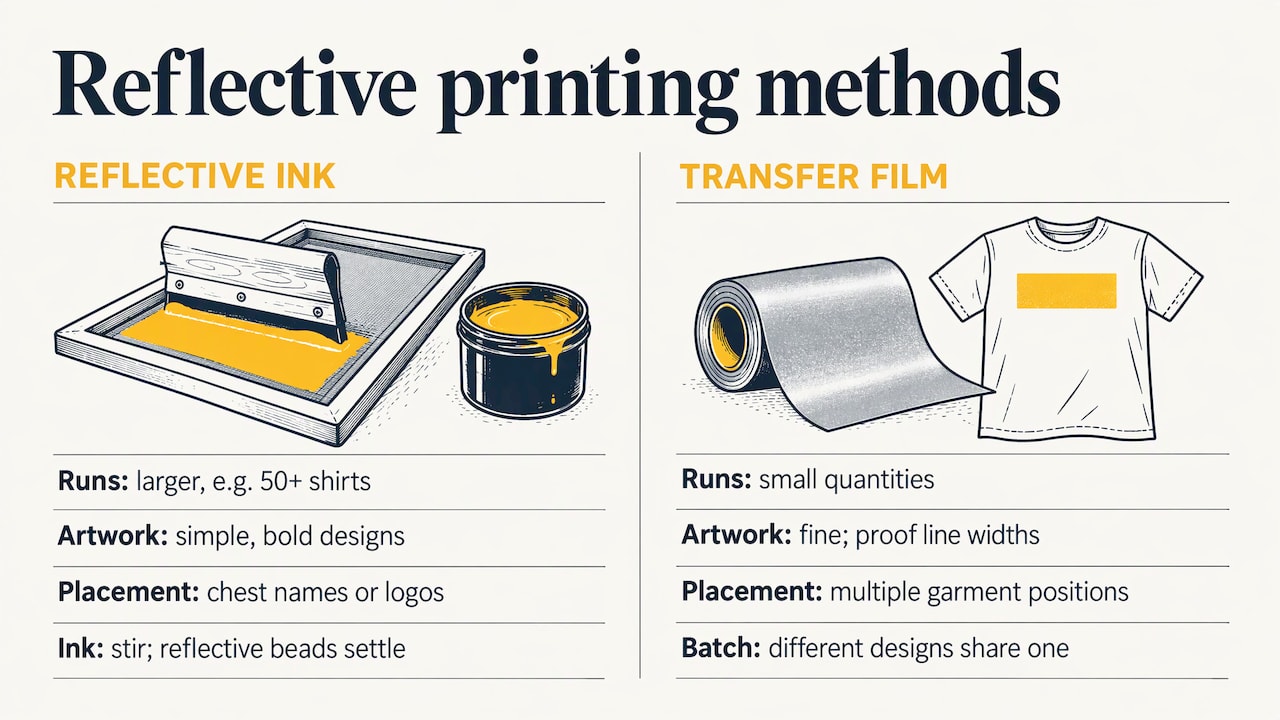
Screen printing with reflective ink suits larger runs of simple, bold artwork, such as a school house name across the chest or a chest logo for fifty or more staff shirts. A trade article on mastering reflective inks gives a flavour of the craft. The ink must be stirred thoroughly before printing because the reflective beads settle. For maximum reflectivity it recommends one flood coat and one squeegee print, so the carrier settles into the fabric while the particles stay on top. It also warns that a mesh count that is too fine can strain the particles out of the carrier, which lowers reflectivity and clogs the mesh.
You do not need to manage any of that yourself. It is useful because it explains why reflective printing is a specialist job and why a quick sample matters.
Reflective transfers are produced separately and pressed onto the garment. They suit small quantities, multi-position placements, and jobs where several different designs share one batch. The artwork can be fine, but limits still apply. The trims guide points out that reflective layers can be too sparse for full night performance at very small sizes, so minimum line widths and type sizes need to be proofed.
If you are still deciding between methods for a regular (non-reflective) design, our own guides explain the trade-offs in plain terms: screen printing versus DTG versus vinyl and screen printing, heat transfer and DTG in Singapore.
Fabrics, colours and designs that work
Fabric
The brightest results come from direct printing onto open-weave fabrics. The manufacturer’s product guide for ASI Reflectives inks explains that the ink sinks into an open weave while the reflective media stays on top, which gives strong reflectivity. The same guide warns against tightly woven nylon and against printing over an underbase, both of which can diminish the effect.
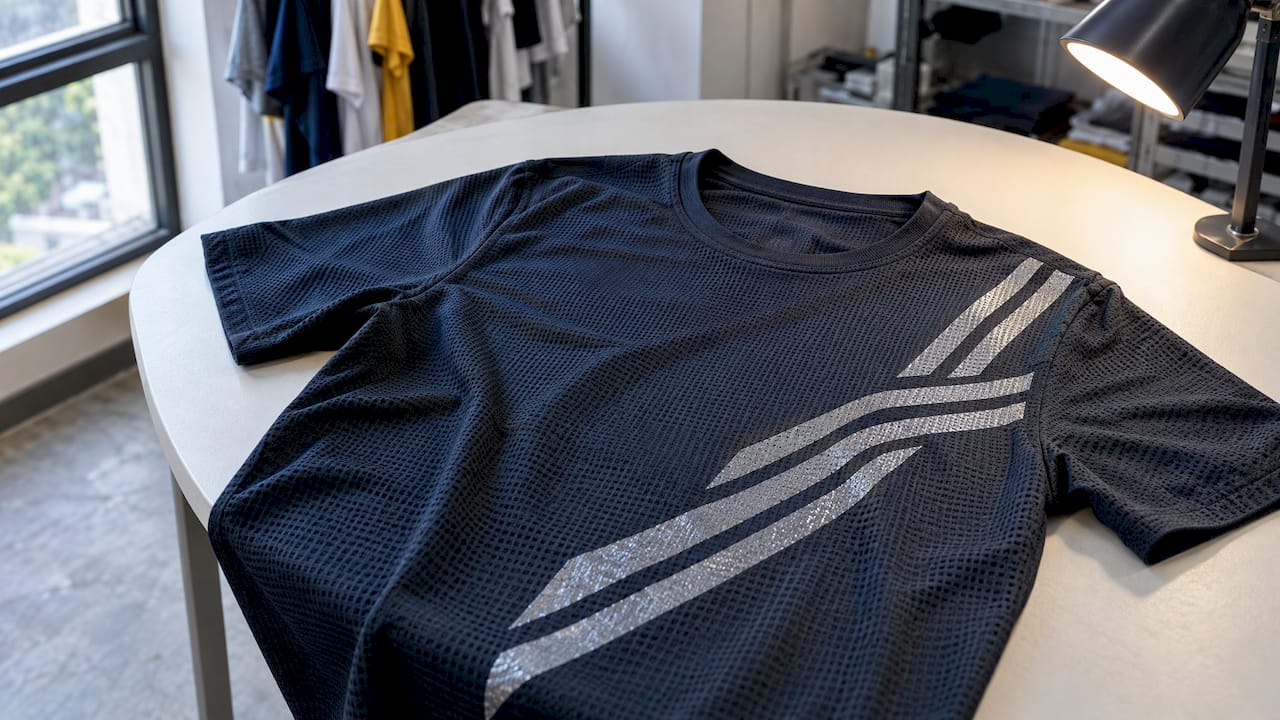
For Singapore’s climate, this matters because most groups want a breathable, quick-drying shirt. Sports teams in particular often choose a performance knit. If your group is sporty and you are weighing fabric choices more broadly, this look at sustainable athlete apparel and gear choices is a helpful companion when you are thinking about what the team will actually wear and keep.
Transfer-based reflective graphics are described by one transfer supplier as suitable for a wide range of fabrics, including cotton, polyester, cotton and polyester blends, and spandex. That range is a manufacturer’s claim, so confirm the match on your exact shirt before the full run.
Colour
On light shirts, reflective ink prints directly. On dark shirts you face a trade-off. The ink trade article says a white underbase can be used when extra opacity is needed, but reflectivity decreases because the base does not soak completely into the fabric. The trims guide agrees that a white base lifts brightness noticeably on dark grounds.
In practice:
- A navy or black shirt with a bold reflective logo looks sharp by day and flashes at night. Accept slightly lower peak reflectivity, or choose a larger graphic.
- A light grey or white shirt gives the cleanest direct print but the reflective graphic will be less visible against the shirt in daylight.
- Fluorescent yellow or orange shirts catch the eye by day. A reflective print on top adds the night element. Whether such a garment meets any safety classification is a separate question, covered below.
Design
Good reflective artwork is bolder than normal artwork. A few rules:
- Go big and simple. Thin lines and small type are where reflective prints lose their punch.
- Avoid high-stretch zones. The trims guide advises keeping prints off elastane panels and underarm compression areas, because the film can craze when stretched.
- Keep it decorative. For branding, the same guide suggests treating the reflective area as an accent rather than the dominant element.
- Think in positions. Chest, upper back, sleeve and the back hem each catch light from different angles. Cars see the back of a runner, not the front.

Do reflective shirts count as safety clothing in Singapore?
A reflective team shirt is not automatically PPE. The line is worth understanding before you order, especially for event crews and facility teams.
Singapore’s workplace safety framework sits in the Workplace Safety and Health Act 2006, which concerns the safety, health and welfare of people at work. Specific venues and employers then set their own PPE requirements. One example: an operations briefing for a major Singapore convention venue states that PPE, such as a high-visibility or reflective vest, should be worn during setup and teardown, and that it must meet Singapore Standards or compatible standards (event venue WSH induction briefing).
The international benchmark is ISO 20471:2013. It groups high-visibility clothing into three classes tied to risk assessment, with each class needing minimum areas of fluorescent background material and retroreflective material. It also sets placement rules: horizontal bands should encircle the torso, and sleeves and trouser legs where applicable. And it states that the minimum visible areas must not be reduced by logos, lettering or labels.
What this means for you:
- If the shirts are for branding, identification and some night-time visibility (school runs, CCA outings, charity walks, marathon support crews), reflective printing is a sensible choice.
- If the shirts will be worn as safety clothing at a worksite or during venue build-up, check the requirement with your safety officer, the venue or your main contractor first. A printed logo does not substitute for a garment that meets the required standard.
- If you need both, plan for a standards-compliant vest or garment as the safety layer and a reflective-printed shirt as the team layer.
Durability and care
Reflective prints are not all equal when it comes to washing. The ink manufacturer’s guide recommends cold machine washing or hand washing with the garment turned inside out, and suggests putting those instructions on the care label. Good advice for any printed shirt in a hot, humid country where shirts get washed often.
For group orders, a simple care card helps. Include the instruction with each bundle so students, staff or volunteers do not tumble-dry the shirts on high heat or iron over the print. Heat is the enemy of most printed graphics. If you need a washing-cycle figure for tender documents, ask the print supplier for the ink or transfer manufacturer’s data rather than relying on a general number.
A pre-order checklist for organisations
The trims guide suggests specifying garment position, fibre content and weight, care conditions and destination standard before you order, and confirming brightness and adhesion on the actual fabric. The ink guide adds that proper ink deposit and a pre-production test for reflectivity, opacity and durability are good practice. Turned into a working checklist:
- Purpose. Is the reflective element for branding, for night visibility on a walk or run, or for a safety requirement? Write it down.
- Garment. Fabric type, weight and colour. Open-weave knits suit direct ink best.
- Artwork. Vector logo, minimum line width, and the biggest size that fits the position.
- Positions. Front chest, back, sleeve. Keep away from stretch zones.
- Dark shirts. Decide whether to accept a white underbase and the lower reflectivity that comes with it.
- Care. Cold wash, inside out, no hot iron on the print.
- Sample. Approve a sample on your actual shirt before the full run.
- Timeline and delivery. Allow time for sampling, particularly if the shirts are needed for a fixed event.
Where reflective printing fits in Singapore
Schools and CCAs can add reflective house names, class numbers or logos to camp and outdoor activity shirts. Corporate teams can use a reflective logo for evening team-building runs or charity events. Event organisers can give volunteers and marshals shirts that stay visible in low light, while a separate vest handles formal safety needs. If you are mapping out occasions, our list of occasions where custom T-shirts make an impression may spark ideas, and our corporate T-shirt printing guide covers team events.
University and polytechnic groups sometimes extend the idea to outerwear. Jackets are a natural place for a reflective accent, since they are worn in the evening. See our page on university and polytechnic windbreaker jacket printing.
Our perspective
We work with schools, businesses, non-profits and event organisers, and the same pattern comes up in almost every brief: people want shirts that identify the group and look good, and they want the order to go smoothly from first idea to delivery.
Reflective printing is a customisation choice that belongs in that conversation early. It affects the fabric, the colour, the artwork size and the print method, so it is much easier to plan at the design stage than to bolt on after the shirts have been chosen. That is why we like to handle the whole process, from design and planning through printing, packing and delivery, so each of those decisions is made with the others in mind.
Our approach is to keep reflective artwork bold and purposeful, to be clear about what a decorative reflective print is and is not, and to match the method to your garment. Our printing technology and full customisation of design, material and delivery are there so that your shirts reflect who your group is and what the event is for.
If you are planning a camp, a run or a team event and want a reflective element, send us the brief and we will recommend a sensible way to get there.
Tommy
Plan your reflective order with us
We produce custom T-shirts, sportswear, jackets and other group apparel for schools, companies, non-profits and event organisers, and we manage design, printing, packing and delivery under one roof. If you want a reflective accent on your team shirts, tell us the quantity, the garment and where the shirts will be worn, and we will advise on the method and layout.

See examples in our T-shirt printing portfolio, read our planning guide for school camp shirts or get in touch through our main page to start your order.
FAQ
Is reflective shirt printing the same as high-visibility clothing?
No. Reflective printing gives a retroreflective graphic on a shirt. High-visibility clothing is a garment built to a standard such as ISO 20471, with minimum areas of fluorescent and retroreflective material in set positions. If a workplace or venue requires high-visibility PPE, check its requirement before you order.
Can reflective prints go on dark T-shirts?
Yes. A white underbase can be printed first to add opacity on dark fabric, which the ink trade guide notes will lower reflectivity somewhat. Choosing bold artwork and a large enough print area helps offset that.
How should I wash a reflective-printed shirt?
The ink manufacturer’s guidance is to hand wash or machine wash cold with the garment inside out. Printing those instructions on the care label, or handing out a care card with the shirts, helps a group order last.
What artwork works best for reflective printing?
Simple, bold shapes: logos, numbers, stripes and short words. Fine lines and tiny type can lose impact, so minimum sizes should be proofed before production. Keep prints off stretchy panels, where reflective film can craze.
Sources
- Reflective Trims Guide: Tape, Print & Glow Marking
- Master Reflective Inks
- ASI Reflectives product guide
- ISO 20471:2013 sample
- Workplace Safety and Health Act 2006, Singapore Statutes Online
- WSH induction briefing, Sands Expo & Convention Centre
Recommended
- A Complete Guide to T-Shirt Printing in Singapore: Materials, Printing Methods, and Costs
- Custom T-Shirt Printing in Singapore: A Complete Guide for Businesses, Schools, and Events
- Top 10 T-Shirt Printing Services in Singapore: How to Choose the Right One for Your Needs
- A Complete Guide to Choosing the Right T-Shirt Material for Printing in Singapore