Good team building shirts do three jobs at once: they split people into teams at a glance, keep everyone comfortable in Singapore’s heat, and give the day a look that people are happy to be photographed in. Get the fabric, colour system and sizing right before you order, and the shirts work. Get them wrong, and you spend the morning swapping sizes and fanning sweaty colleagues. We print custom shirts for businesses, schools, non-profits and event organisers, and we handle the whole job from design through printing, packing and delivery, so this guide follows the order in which an organiser makes decisions.
TL;DR
- Choose breathable, moisture-wicking fabric for active programmes and a soft cotton tee for indoor workshops and dinners.
- Use colour to mark teams, and keep one shared element, such as the logo or event name, on every shirt.
- Collect sizes early, add a small buffer for late joiners, and lock the design before production begins.
- Keep the artwork to two or three colours and a clear focal point, so it prints cleanly and reads from a distance.
- Send us your headcount, event date and rough idea, and we take care of design, printing, packing and delivery.
Table of Contents
- Start with what the day looks like
- Why fabric matters more in Singapore
- Use colour to build the teams
- Designing the shirt
- Choosing the printing method
- Sizing without the headaches
- A simple timeline
- Who is ordering, and what they need
- Common mistakes to avoid
- Our view on team building shirts
- Ready to order?
- FAQ
- Sources
Start with what the day looks like
The right shirt depends on what your group will actually do in it. Before you think about slogans, write down three facts: the activity, the venue and the headcount.
- Outdoor and active programmes (amazing race, obstacle courses, sports days, laser tag): you need a light, quick-drying shirt that moves with the body.
- Indoor workshops and offsites: comfort matters more than performance, so a soft cotton or cotton-blend tee works well.
- Mixed days (a morning workshop followed by an afternoon game): a moisture-wicking shirt covers both, and it will not look out of place at the lunch table.
- Photo-heavy events: pick colours that hold up on camera and artwork that stays legible when people are standing in a group.
If your day includes a physical activity such as a laser tag session, plan the shirts around movement: lighter fabric, a relaxed fit and print placement that does not bunch under straps or vests.
Why fabric matters more in Singapore
Singapore’s climate is hot and wet throughout the year. The national weather service describes it as having uniform temperature and abundant rainfall all year, so there is no cool season to rely on. A shirt that feels fine in an air-conditioned meeting room can feel heavy after twenty minutes outside.
The practical choice comes down to two families of fabric:
| Fabric | Best for | What to expect |
|---|---|---|
| Cotton or cotton blend | Indoor workshops, dinners, giveaways people will wear again | Soft and familiar, takes print well, holds moisture when you sweat |
| Dri-fit style polyester | Outdoor games, sports days, long active programmes | Lightweight, designed to draw moisture away from the skin, dries quickly |
| Singlet or sleeveless | Very active, sports-style events | Maximum airflow, a sporty look |
| Windbreaker jacket | Cold offices, overseas trips, a premium touch for staff or leaders | Adds a layer that carries the same branding |
We offer dri-fit sports apparel, singlets, caps and windbreaker jackets alongside standard T-shirts, so you can mix them in one order. For instance, participants wear dri-fit tees on the day while facilitators get a jacket in the same colours.
Use colour to build the teams
Colour is the simplest way to make teams visible. Participants understand their group instantly, facilitators can spot who belongs where, and nobody needs a name tag to know which table to sit at.
A few rules that keep it working:
- Limit the number of teams to colours people can tell apart. Red, blue, green and yellow are far easier to separate across a field than navy and black, or two shades of green.
- Think about the venue. Bright colours stand out in a park or a hall. Pastels can wash out in strong sunlight.
- Keep one thing the same on every shirt. A shared logo, event name or tagline on the chest ties four colours together as one event.
- Be careful with white and very light colours for messy or outdoor activities, unless you are happy for them to be part of the story.
- Check the print contrast. Light ink on a light shirt disappears. Pair dark artwork with light shirts and light artwork with dark ones.
If you want teams to feel ownership, give each one a name and a small icon on the sleeve or back while keeping the main design identical. People remember a shirt that has their team’s name on it.
Designing the shirt
The best team building designs are simple. The shirt will be seen from a distance, in motion, and in group photos, so a clear idea beats a detailed illustration.
Pick one focal point
Choose a single message: the event name, a team name, a short slogan or your company logo. Put it on the chest or centre back and give it space. A crowded layout with five slogans and three logos looks busy and prints less sharply.
Keep the colour count low
Two or three ink colours is a sensible target. It keeps the design bold, makes the print cleaner and makes it easier to match your brand colours. Gradients and photographic images are possible with some printing methods, but a graphic with flat colour tends to look strongest on a team shirt.
Plan the placement
- Front chest: the logo or event name, usually small to medium.
- Back: a larger slogan, the team name or a list of participants’ names, if you want a souvenir feel.
- Sleeve: the year, a team icon or a sponsor mark.
- Name or role line: helpful for events where participants do not know each other.
Slogans that work
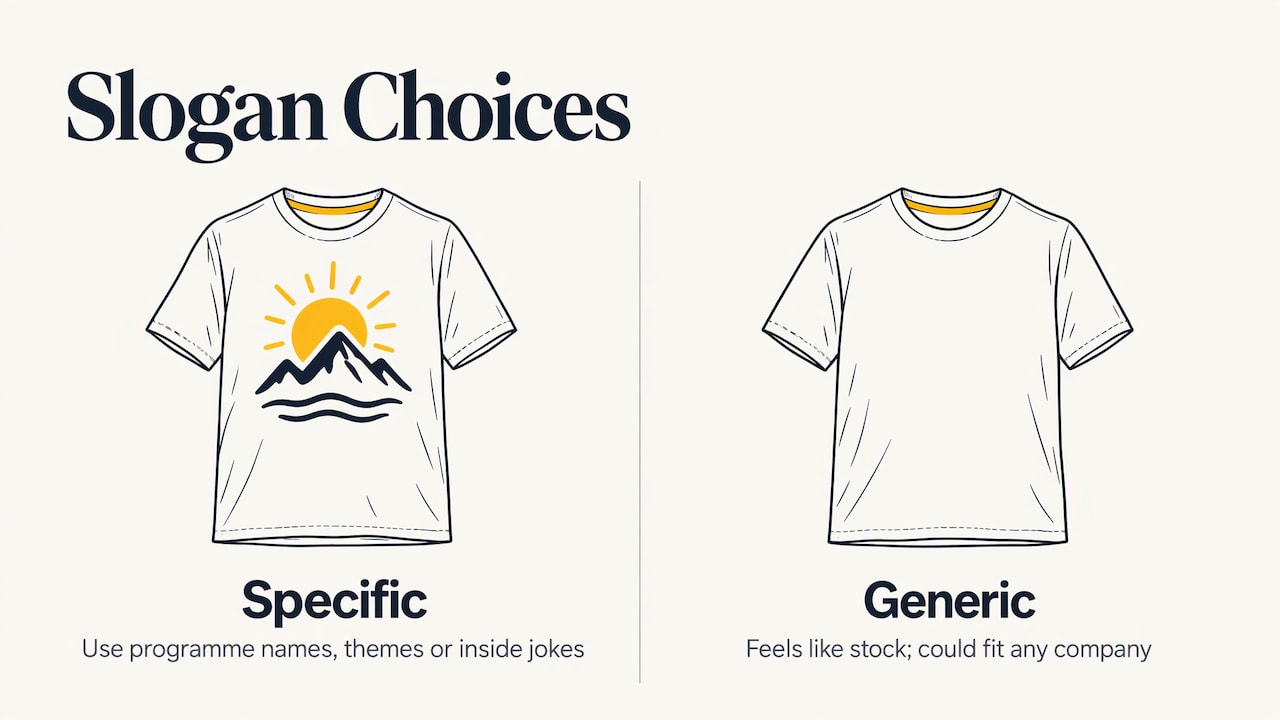
Short and specific wins. Use something that refers to your actual programme, such as your department name, the challenge theme or an inside joke the group will recognise. Avoid generic lines that could apply to any company, because they make the shirt feel like stock. If you want more inspiration on themes, our list of creative printing ideas for corporate events is a good place to start, and our guide to designing shirts that look great after printing is written for people who are not designers.
Choosing the printing method
The method affects how the shirt looks, feels and wears. In broad terms:
- Screen printing suits larger orders with simple, solid-colour artwork, and gives strong, durable colour.
- Direct-to-garment (DTG) suits detailed or multi-colour artwork where you want a softer feel.
- Heat transfer vinyl is a clean way to add names, numbers or small logos, which helps when each person’s shirt carries something different.
The right choice depends on your artwork, quantity and fabric. Our comparison of screen printing, DTG and vinyl explains the differences in plain terms, and our guide on choosing the best printing method helps you match one to your project. We use advanced printing technology and can recommend the method that suits your design and fabric.
Sizing without the headaches
Sizing is where most organisers lose time. A few habits prevent it.
- Collect sizes early. Send a short form as soon as the date is confirmed. Ask for size and, if you want it, a name or nickname for the print.
- Offer a size guide. People often guess wrong. A basic chart showing chest width and length removes most doubt.
- Allow for different fits. Some participants prefer a looser fit, particularly in hot weather. Say so on the form.
- Order a small buffer. Late joiners and wrong guesses are normal. A few extra shirts in common sizes cover them.
- Plan for facilitators and guests. Add them to the headcount so they do not end up in a different shirt.
If your group includes colleagues who prefer modest attire, mention it at the start. We produce Muslimah attire as well as standard T-shirts, so everyone can wear the same design in a style that suits them.
A simple timeline
Work backwards from your event date. We do not publish fixed turnaround figures here, so confirm the production schedule with us when you share your brief, and build in buffer around these stages.
| Stage | What happens | What you do |
|---|---|---|
| Brief | Event, headcount, activity, rough idea | Share it with us |
| Design | Artwork and layout prepared | Review and approve |
| Sizes | Names and sizes collected | Send the final list |
| Production | Printing and packing | Nothing, apart from staying reachable for questions |
| Delivery | Shirts arrive at your office, school or venue | Check counts and distribute |
The step people most often leave late is the final size list. The second is design approval, because several stakeholders want a say. Decide who has the final word before the first draft arrives.
Who is ordering, and what they need
Businesses and HR teams. You want a shirt that looks like your brand without looking like a uniform, and that staff will wear again. A clean logo, a good fabric and consistent colours do that. Our page on corporate T-shirt printing for team building goes deeper, and if you want shirts for daily use, see company uniform shirt printing.
Schools and CCAs. Class camps, orientation and CCA bonding days need shirts that are affordable, easy to size across many students and consistent from year to year. We have pages on school camp shirts and on why customised CCA shirts build team spirit.
Non-profits. Volunteer days and fundraising events benefit from shirts that make volunteers easy to find and carry your cause. Keep the design simple and the message clear.
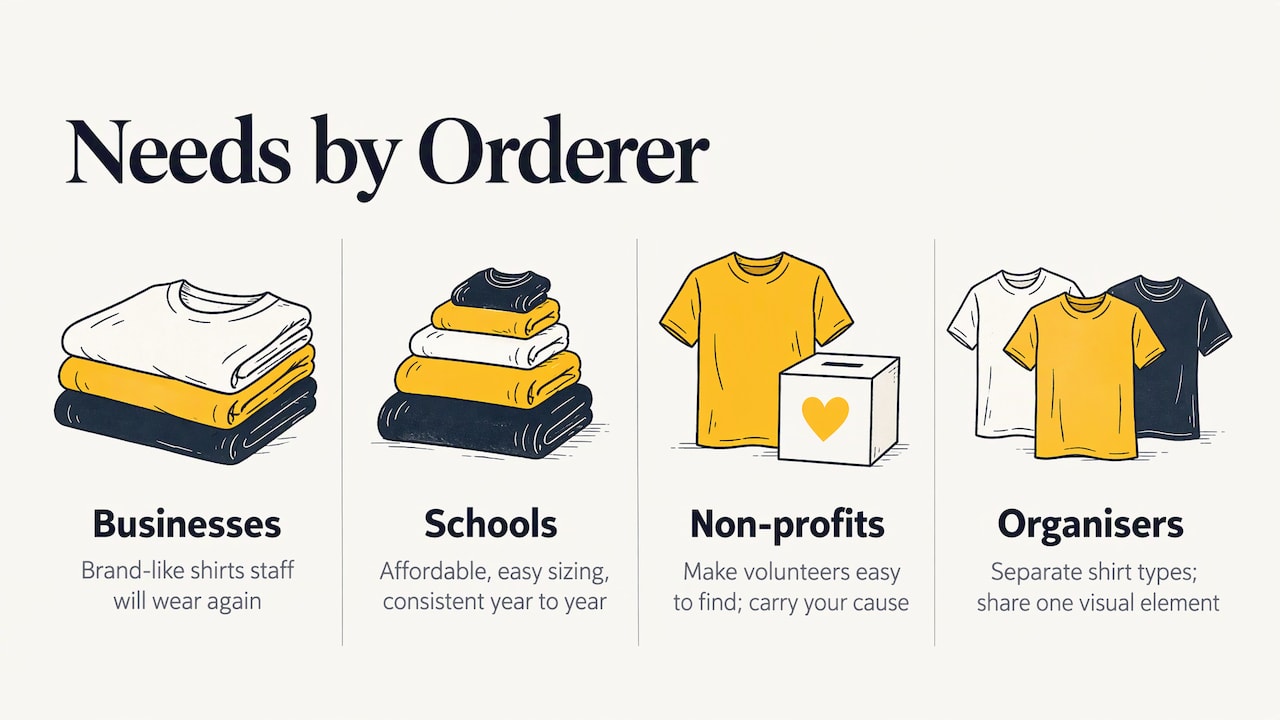
Event organisers. You have the most moving parts: sponsors, staff, participants and guests. Plan separate shirt types for each group and keep one visual element common to all. Our event shirt planning guide walks through that.
Common mistakes to avoid
- Choosing the shirt before the activity. Heavy cotton for a sports day is the classic error.
- Too many colours in the artwork. The result is muddy at a distance.
- Late size collection. It pushes the whole schedule.
- Poor contrast. Light print on a light shirt, or dark on dark.
- Tiny text. Anything under a certain size is unreadable on a moving person. If you want a list of names, put it on the back at a readable size.
- No single decision maker. Design by committee leads to delay.
Our view on team building shirts
We have seen the same pattern in team building projects for schools, companies and non-profits: the shirt that works is the one planned around the day, not the other way round.
Our approach is to start from your activity and headcount, then choose the fabric, colours and print method that fit. We handle design, printing, packing and delivery, so the organiser has one point of contact instead of four.
A shirt is the only part of a team building day that people take home. If it is comfortable and well made, it gets worn again, and your event stays visible long after it ends. That is why we put effort into customisation, from material and design through to delivery.
Tommy
Ready to order?
We manage the full process for team building shirts: design and planning, printing, packing and delivery. Whether you need shirts for a class camp, a company retreat, a charity run or a conference, share your headcount, event date and idea, and we will take it from there.
You can browse past work in our T-shirt printing portfolio, read about event T-shirt printing in Singapore, or go straight to our main page to start your order.
FAQ
What material is best for team building shirts?
It depends on the activity. For outdoor or active games, a lightweight moisture-wicking dri-fit style shirt is the comfortable choice in Singapore’s year-round heat. For indoor workshops, a soft cotton tee works well. If your day mixes both, dri-fit covers it.
How many colours should I use for different teams?
Use as many colours as you have teams, but keep them clearly distinct from each other, such as red, blue, green and yellow. Put the same logo or event name on every shirt so the colours still read as one event.
What should I print on a team building shirt?
Choose one focal point: the event name, a team name, a short slogan or your logo. Add a team name or role on the back or sleeve if you want a personal touch. Keep the artwork to two or three colours so it stays sharp and readable.
When should I order team building shirts?
Start as soon as the date and headcount are firm, because the size list and design approval are the stages that take longest. Share your event date with us in your first message, and we will confirm the schedule against it.
Sources
- Meteorological Service Singapore: Climate of Singapore
- Corporate team building with laser tag in Singapore