The right restaurant staff shirt is breathable enough for a Singapore kitchen or dining floor, cut so people can move, printed with a logo that survives weekly washing, and easy to replace when someone joins. Get those four things right and your team looks consistent, guests know who to ask for help, and you are not reordering every few months. This guide covers styles by role, fabric and colour, branding methods, hygiene expectations, sizing, care and what to brief a printer on.
TL;DR
- Match the shirt to the role: relaxed printed tees for casual cafés and hawker-style outlets, polos for counter and floor staff, woven shirts for fine dining, and a separate, easily washed option for kitchen teams.
- In Singapore’s heat and humidity, favour lightweight, breathable fabrics and test a sample after several washes before ordering in bulk.
- Choose the logo method by fabric, artwork and volume, and ask for a wash test on the real garment.
- NEA expects service staff to wear clean, tidy attire and change it daily or when soiled, so order at least two to three shirts per person.
- Order a few extra sizes and spare shirts for new hires, and keep the approved artwork on file for reorders.
Table of Contents
- Start with the role, not the catalogue
- Fabric, fit and colour for Singapore’s climate
- What Singapore expects of food service attire
- Putting your brand on the shirt
- Sizing a team and keeping shirts looking right
- Perspective: what we see when restaurants order
- Retail staff uniforms: the same logic, a different floor
- Choosing a printer for staff shirts
- Order staff shirts with us
- FAQ
- Sources
Start with the role, not the catalogue
A “staff shirt” means different things in a bubble tea kiosk, a banquet hall and an open kitchen. Before you look at samples, list the roles and what each one does for most of a shift. Standing, carrying trays, bending over a fryer, wiping tables and greeting at the door all put different demands on a garment.
| Role | Typical demands | Shirt styles that tend to suit |
|---|---|---|
| Front of house, casual café or restaurant | Constant movement, guest-facing, visible branding | Printed T-shirt or polo in a solid brand colour |
| Front of house, fine dining | Polished look, less visible branding | Woven shirt or blouse, small chest logo |
| Counter and takeaway | Fast service, heat from equipment | Breathable tee or polo, logo front and back |
| Kitchen | Heat, splashes, frequent changes | Lightweight, quick-drying tee in a colour that hides stains |
| Delivery and event catering | Outdoors, long hours, brand visibility | Dri-fit style shirt, optional light jacket |
| Managers | Authority, recognisable at a glance | Different colour or collar style from the team |
The point of the table is contrast. If servers, kitchen staff and managers all wear the same thing, guests cannot tell who to ask. A simple colour or collar difference solves that without extra design work.
Casual venues: T-shirts and polos
For cafés, food courts, bars and fast-casual outlets, a printed T-shirt is the workhorse. It is inexpensive per piece, easy to size, and the print area on the chest and back is generous enough for a logo, a tagline or a QR code. Polos add a collar, which reads as a step more formal and often suits managers or counter staff who face guests directly.
Fine dining: woven shirts and discreet branding
If your concept is more formal, a woven shirt in a neutral shade with a small, tonal logo looks right. The trade-off is that woven fabrics can feel warmer, so test one on a full shift before committing the whole team, especially for staff working near the pass or the grill.
Kitchen teams: practical first
Kitchen shirts take the most punishment. They should be light, wash well and tolerate frequent changing. Dark or mid-tone colours hide the day’s marks better than white, though many kitchens prefer lighter colours precisely because they show when something needs washing. Decide which philosophy suits your operation and stay consistent.
Fabric, fit and colour for Singapore’s climate
Singapore is hot and humid all year, and restaurant floors and kitchens are warmer still. The shirt is worn for eight to twelve hours, so comfort is a business decision: uncomfortable staff are slower and quicker to leave.
Fabric. Lightweight cotton and cotton blends feel natural against the skin. Performance polyester, the kind used in sports dri-fit shirts, dries quickly and resists sweat marks, which matters for staff who run between kitchen and tables. Blends try to balance both. Ask your printer for physical samples of two or three fabrics and have staff from different roles wear them for a full shift. Their feedback beats any specification sheet.
Fit. A shirt that is too tight restricts reaching and bending; too loose gets caught on equipment and looks untidy. Offer men’s and women’s cuts where possible, and check sleeve length against the work: short sleeves are standard in warm kitchens, and long sleeves suit formal service.
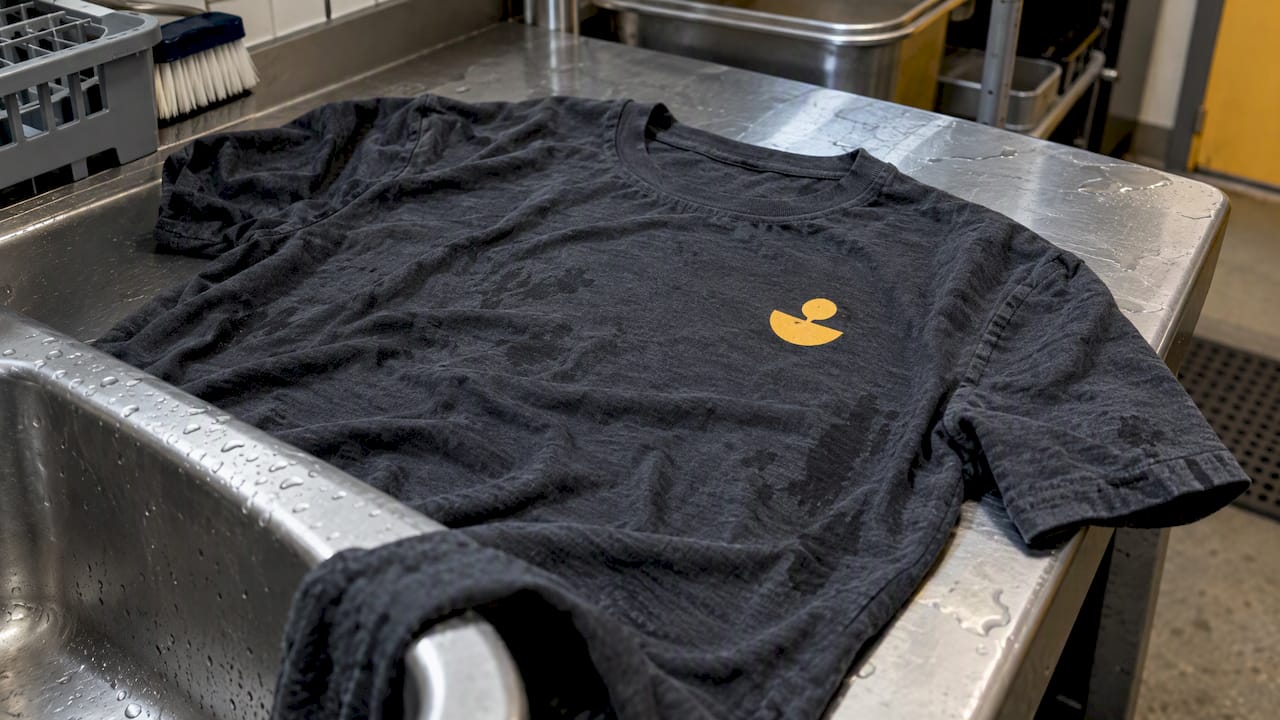
Colour. Colour should match your brand, hide the kind of mess your menu creates, and print well. Dark shirts need a print method that keeps light logos bright. Very light shirts show perspiration and sauce more readily. Mid-tones are forgiving.
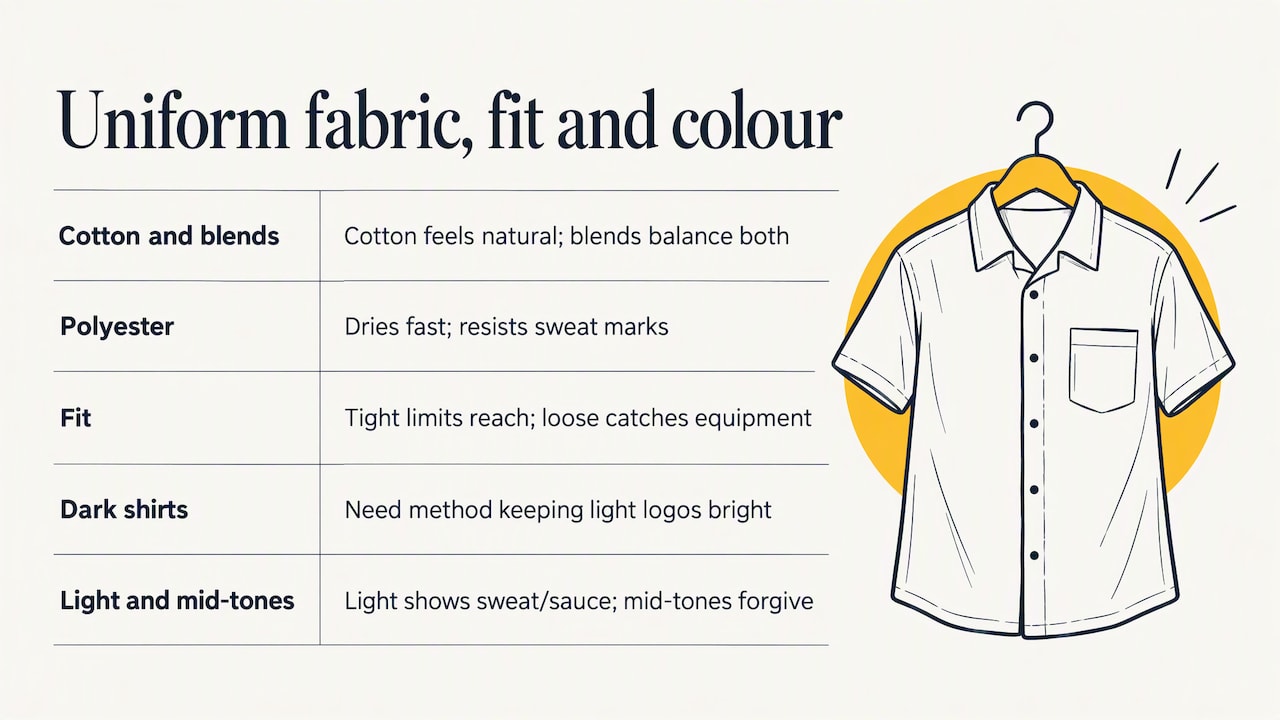
Colour fastness. A shirt that fades after a month undermines the professional image you paid for. Singapore’s National Environment Agency (NEA) guide on uniforms for the environmental services industry makes the point that uniforms should use materials with good colour fastness, and it refers to international test standards such as ISO 105-B02 and ISO 105-E01 so uniforms do not wash out easily. That guide is written for a different industry, but the principle carries over directly: ask your supplier how the fabric and colour perform in repeated washing, and do your own wash test before a large order.
What Singapore expects of food service attire
Uniform choice sits inside hygiene rules, so it is worth knowing them.
The Environmental Public Health (Food Hygiene) Regulations require people engaged in selling or preparing food to wear clean attire, keep their bodies and fingernails clean and short, cover open hand cuts with waterproof dressings, and wash their hands thoroughly with soap and clean water before work and after using the toilet.
NEA’s Guidelines on Good Hygiene Practices by Service Staff at Food Establishments go further on attire. They ask service staff to wear clean, proper and tidy attire, changing it daily or whenever it becomes soiled. The same guidance says hair and beards should be neat and tidy, and long hair tied back with restraints such as caps.
What this means for your order:
- Quantity. If staff must change daily or when soiled, one shirt per person is not enough. Two to three per person lets them rotate through the wash without gaps.
- Caps and hair restraints. If your outlet wants matching caps, consider ordering them with the shirts so the look is coordinated and hair rules are easy to follow.
- Easy-care fabric. Shirts that need ironing or special washing will not be changed as often as the rules expect. Pick fabrics that survive a fast wash and dry quickly.
- Gloves and other hygiene supplies. Uniforms are only one part of clean food handling. If you are also reviewing disposable supplies, this guide to vinyl gloves for catering is worth reading alongside your uniform decisions.
For anything specific to your licence category, check the NEA pages directly or ask your licensing officer. Rules apply by establishment type.
Putting your brand on the shirt
A logo turns a plain shirt into a uniform. How you apply it affects look, feel and lifespan.
Common methods
- Screen printing. Strong, opaque colour and good value on larger runs, especially with simple logos in a few colours. Setup effort means it is less economical for very small batches.
- Digital printing (DTG). Suits detailed or multi-colour artwork and smaller quantities, with softer results on suitable fabrics.
- Heat-applied vinyl. Crisp, solid shapes and good for names, numbers or single-colour logos on performance fabrics.
- Embroidery. A premium, textured finish often used on polos and woven shirts. Check with your supplier whether it suits the fabric you chose.
Our own guides go deeper on the trade-offs, including screen printing versus DTG versus vinyl and how to choose the best printing method for a business.
Design decisions that save trouble later
- Keep the logo readable at a glance. A guest across the room should read your name or recognise your mark. Simple beats busy.
- Place it where it is visible when working. Left chest for the standard look; the back for large branding, which suits delivery teams and events. An apron can cover the front, so check where the logo ends up on the job.
- Limit colours. Fewer colours reduce cost and make reorders match.
- Mind contrast. A dark logo on a dark shirt vanishes. Ask for a mock-up on your actual shirt colour.
- Avoid thick, heavy prints on hot-weather shirts. Large solid blocks can feel stiff and warm against the skin.
- Save the final artwork. Keep the approved files and the exact colour references so a reorder six months later matches the first batch.
If you do not have a designer, our guide on designing T-shirts that look great after printing is written for non-designers.
Test before you commit
Ask for a sample printed on the actual fabric and colour, then wash it repeatedly the way your laundry routine will. Look for cracking, peeling, fading and shrinkage. It is a small cost compared with reprinting a full team order.
Sizing a team and keeping shirts looking right
Sizing is where many bulk orders go wrong.
Collect sizes properly. Have each person try a sample set of sizes, rather than guessing from their usual T-shirt. Record the size and fit (men’s or women’s cut) beside each name.
Allow for change. Staff turnover is normal in food service. Order a small buffer of the most common sizes so a new hire can start on day one in the right uniform, rather than waiting for a reorder.
Allow for shrinkage. Ask your supplier how the fabric behaves in the wash. If there is any shrinkage, size accordingly and wash a test piece first.
Care routine for the team.
- Wash promptly after each shift; soiled shirts left in a bag are harder to clean.
- Turn printed shirts inside out and avoid harsh bleach unless the supplier says the fabric and print tolerate it.
- Follow the care label on the shirt, and print it on a simple card so every staff member sees the same instructions.
- Avoid high-heat drying on printed areas unless advised otherwise.
- Retire shirts that are badly stained, thinning or peeling. Faded or damaged shirts work against the clean, professional appearance you wanted.
Plan a replacement rhythm. Review the stock of shirts every few months, and reorder before you run short, not after. A printer can usually turn a repeat order faster when the artwork and colours are already on file.
Perspective: what we see when restaurants order
We print for schools, businesses, non-profits and event organisers, and the lessons from those orders carry directly into food and beverage teams.
The first is that people choose by picture and regret it by the fifth wash. A mock-up looks fine; a garment worn through a lunch rush and a weekly wash tells the truth. That is why we encourage samples and wash tests before a bulk run, whatever the print method.
The second is that the process is easier when one party manages it from design to delivery. When artwork, printing, packing and delivery sit with the same team, there are fewer handovers where files, sizes or colours go astray. That is how we run orders: design and planning, printing and packing, and delivery to your outlet.
The third is that simple wins. A clean logo, a sensible colour and a fabric that suits Singapore’s climate will outlast a clever design every time. Start with your team’s comfort, make the brand clear, and the look follows.
— Tommy
Retail staff uniforms: the same logic, a different floor
Many readers asking about restaurant shirts also run shops, and the thinking carries over. Retail teams are on their feet, handle customers all day and need to be spotted quickly.
- Recognisable. A consistent colour and visible logo let shoppers find help at once. Put branding on the front and back, since staff are approached from both sides.
- Comfortable for the day. Retail floors are air-conditioned but staff still move stock, climb ladders and work in storerooms. Breathable fabric and a relaxed cut matter.
- Easy to layer. A lightweight printed jacket or windbreaker helps in cold, over-air-conditioned stores. We print custom windbreaker jackets for teams that need a second layer.
- Easy to reorder. Seasonal hiring and promotions mean you will reorder; keep sizes and artwork recorded.
For office and front-desk wear, see our notes on uniform printing and what to consider for office wear, and our page on company uniform shirt printing.
Choosing a printer for staff shirts
You will find options from online platforms to local print shops. If you are comparing, custom T-shirt sites for events with fast proofing and rush options show what an online ordering flow looks like. For a restaurant, a few questions matter more than speed alone:
- Can they print on the fabric and colour you chose, and show a sample?
- Do they offer design support if your logo is not print-ready?
- What are the minimum quantities, and how are reorders handled?
- How are sizes managed for a mixed team, and can extra sizes be added later?
- Who handles packing and delivery to your outlet, and what lead time should you plan for?
- Can they show earlier work? Look through a printing portfolio to judge quality.
Plan ahead for openings, rebrands and seasonal peaks. Ask for the current lead time at the start rather than assuming it.
Order staff shirts with us
We handle custom T-shirt printing for businesses, including food and beverage teams: design and planning, printing and packing, and delivery. We also produce sportswear, caps and jackets if your team works outdoors or delivers. Tell us your roles, headcount, preferred colours and logo, and we will guide you on fabric, print method and sizing. Prices depend on the project, so request a quote from our main page.

If you want to see more of how we work with corporate teams, read our guide to corporate T-shirt printing or browse event and staff attire printing.
FAQ
How many shirts should each restaurant employee have?
Plan for at least two to three per person. NEA’s guidance asks service staff to change their attire daily or when it is soiled, so a single shirt leaves no room for the wash. Kitchen staff, who get messier, may need more than front-of-house.
What fabric is best for staff shirts in Singapore?
Lightweight, breathable cotton or cotton blends and quick-drying performance fabrics suit the climate. The right one depends on the role, so ask for samples and let staff wear them through a full shift. Wash the sample several times to check colour and shape.
Is printing or embroidery better for a restaurant logo?
Printing suits larger runs, bigger artwork and lightweight tees, while embroidery gives a textured, premium look on polos and woven shirts. Consider the fabric, the number of colours and the budget. A printed sample washed several times will show you how the finish ages.
Do Singapore rules say what restaurant staff must wear?
The regulations require people preparing or selling food to wear clean attire, and NEA guidance asks for tidy attire and hair restraints for long hair. They do not prescribe a particular shirt style, so the choice is yours within those hygiene expectations. Check with NEA for your specific licence type.
Can the same shirts work for retail staff?
Yes, the same principles apply: breathable fabric, a clear logo, a consistent colour and easy reordering. Retail teams often add a light jacket for cold, air-conditioned stores. Give your printer the roles and working conditions first.
Sources
- Guide on Uniforms for Environmental Services Industry, NEA
- Environmental Public Health (Food Hygiene) Regulations, Singapore Statutes Online
- Guidelines on Good Hygiene Practices by Service Staff at Food Establishments, NEA
- Wholesale vinyl gloves for catering
- Best custom T-shirt sites for events