A good construction work shirt for Singapore is loose-fitting, light in colour, made from breathable fabric, and cut so a worker can reach, bend and kneel all day. Add high-visibility features where there is traffic or poor light, and keep in mind that a shirt is workwear, not protective equipment. If you are ordering for a whole crew, the logo, the print method and the care routine matter almost as much as the fabric.
This guide is written for contractors, subcontractors, site managers and procurement teams who need to outfit workers, not for someone buying a single shirt. It uses Singapore’s own guidance on heat and workwear, and it ends with what to settle before you place a bulk order.
TL;DR
- Choose loose-fitting, light-coloured, breathable shirts: this is the clothing advice Singapore’s Ministry of Manpower (MOM) and the WSH Council give for hot outdoor work.
- Add reflective or high-visibility features only where the job needs them, such as traffic routes or dim light. A printed shirt is not PPE unless the garment itself is certified as such.
- Check mobility, seams and pockets by wearing the sample through a real task, not by looking at it on a hanger.
- Decide logo size, placement and print method before you order, and test the print on the actual fabric.
- Order a sample, approve it, then place the full run with sizes confirmed per worker.
Table of Contents
- What a construction work shirt actually has to do
- Fabric and fit for Singapore’s heat
- When high-visibility and reflective features are needed
- A work shirt is not PPE
- Where shirts fit in Singapore’s heat-stress rules
- Durability, pockets and mobility
- Adding your logo and branding
- Our perspective: treat the shirt as part of your safety culture
- Ordering branded work shirts for your crew
- Caring for work shirts so they last
- FAQ
- Sources
What a construction work shirt actually has to do
A site shirt has four jobs. It keeps the wearer as cool as possible, it survives repeated washing and rough handling, it lets the body move freely, and it identifies the worker and the company. Everything else, from collar style to pocket count, serves one of those four.
Singapore adds one constraint that most overseas shirt guides ignore: heat and humidity every day of the year. The WSH Council’s guidance on managing heat stress says workers should wear loose-fitting, light-coloured clothing, and it warns that impermeable clothing can limit air movement and sweat cooling, while heavier clothing can raise the body’s workload. A thick, stiff drill shirt that looks rugged in a catalogue can work against the person wearing it.
The product listings that dominate search results for this keyword, many of them imported long-sleeve cotton work shirts sold by the piece, tend to lead with toughness and price. For a Singapore site, comfort in heat comes first, because a worker who is overheating is a safety problem and a productivity problem.
Fabric and fit for Singapore’s heat
Light colours and loose cuts
MOM’s summary of adverse-weather guidelines recommends good ventilation and loose-fitting, light-coloured clothing as part of heat-stress control, next to drinking water, shaded rest and WBGT monitoring. The WSH Council’s 2022 Q&A says the same: workers in hot environments should generally wear breathable, loose-fitting and light-coloured clothing.
There is a practical catch. Light colours show dirt. NEA’s guide on uniforms for the environmental services industry suggests considering light-coloured uniforms and light, breathable materials in Singapore’s warm climate and strong sunlight, unless they are prone to staining. That guide is written for another industry, but the reasoning carries over. For dusty, muddy or oily trades, a mid-light shade or a lighter colour with a darker panel on the lower sleeves and hem can balance heat against appearance. Whatever you pick, wash a sample before you commit.
Fabric choices
Three broad families are worth comparing.
| Fabric type | Strengths | Watch out for |
|---|---|---|
| Cotton or cotton-rich woven | Familiar, durable, comfortable against skin | Holds sweat, dries slowly, can feel heavy when soaked |
| Polyester or performance knit (dri-fit style) | Quick-drying, light, wicks moisture | Can hold odour; check the fabric is not too thin for abrasion |
| Cotton-polyester blend | Middle ground on cost, feel and drying time | Quality varies a lot between mills, so test a sample |
Academic work supports the case for engineered fabrics. A Hong Kong study on smart work wear for construction workers chose 100% Coolmax for the polo shirt and added inside mesh for ventilation. The study reports that its prototype reduced heat storage by 28.8% and improved thermal comfort by 14.2% compared with traditional uniforms. It is a prototype tested in a different city, so treat it as a direction, not a guarantee, but it shows that fabric and construction choices change how hot a shirt feels.
Researchers writing in Ergonomics describe heat stress in construction as a design problem that balances moisture transport, UV protection and ergonomic mobility together rather than one property at a time. That is a useful way to read any fabric spec: ask how it handles all three, not just which one the supplier is proudest of.
Long sleeve or short sleeve
Long sleeves protect forearms from sun, scrapes and splashes, and in Singapore many contractors prefer them for outdoor trades. The trade-off is heat. A lightweight, breathable long sleeve with a loose cut and roll-up tabs is usually more comfortable than a heavy one. Short sleeves suit indoor fit-out, supervisors and site visitors. If your crew spans both, you can issue both, in the same colour and with the same logo, so the team still looks like one company.
When high-visibility and reflective features are needed
Not every site shirt needs reflective material, but some do. NEA’s uniform guide says high-visibility designs, such as reflective strips and bright colours, should be incorporated for outdoor environments with high vehicular traffic or dim lighting. That guide covers the environmental services industry, not construction, so it is not a construction-site rule, but the principle is a sensible benchmark.
In practice, think about who works near moving vehicles, who works at dusk or at night, and who guides traffic or lorries. For those roles, a hi-vis shirt or a hi-vis vest over the work shirt is the safer choice. For a worker in a fully enclosed, well-lit interior, it adds cost and heat for little benefit.
Two cautions when you plan this:
- A vest or jacket required by your safety officer or main contractor should meet whatever standard they specify. Confirm the requirement with them before you order, not after.
- Printing a logo over reflective tape, or placing it so it covers the tape, can undo the point of the tape. Plan the layout so the logo and reflective bands do not compete.
A work shirt is not PPE
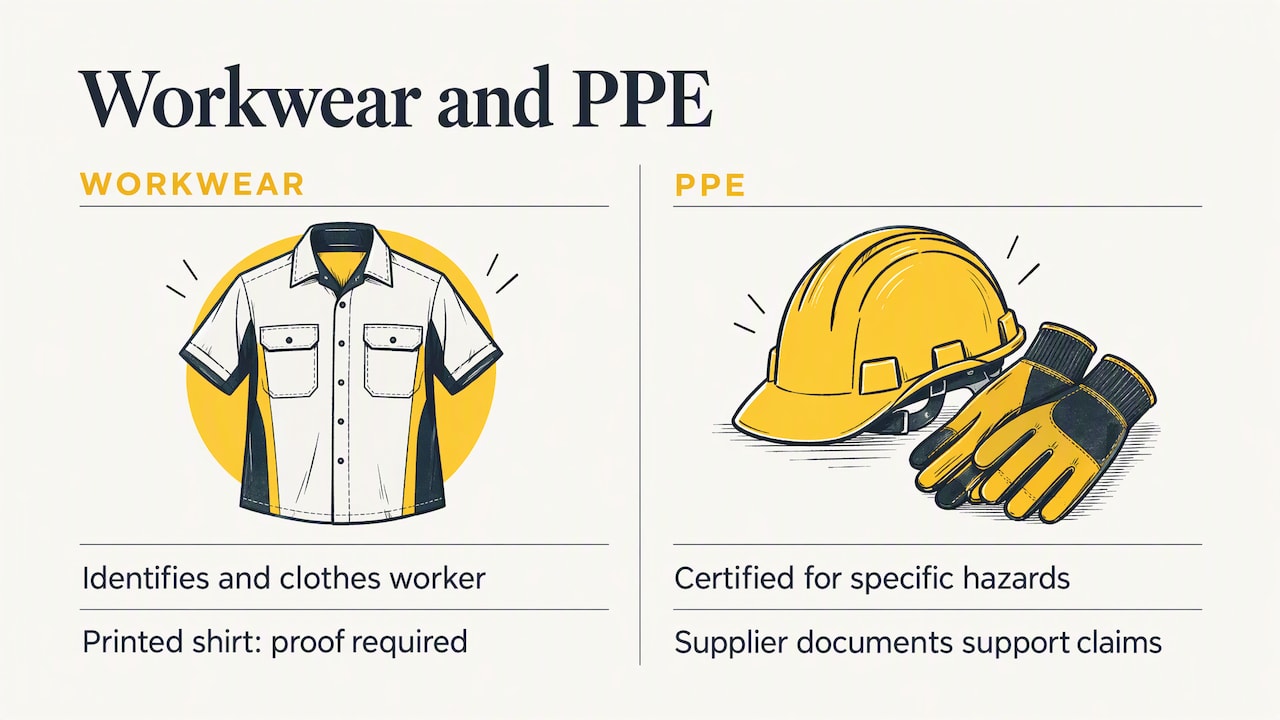
This distinction saves companies from awkward claims. Workwear identifies and comfortably clothes the worker. Personal protective equipment is certified to protect against a specific hazard. NEA’s uniform guide states that clothing should not jeopardise health or safety and that employers should provide PPE such as gloves, helmets, masks and anti-slip shoes where appropriate.
So do not describe an ordinary printed shirt as flame-resistant, anti-scald or protective unless the exact garment has evidence to support it. Listings that promise “anti-scalding” or “wear-resistant” cotton shirts at very low prices are making claims you should not repeat to your workers or your clients without proof. If a task needs arc, flame or chemical protection, that is a PPE purchase made through a PPE supplier, with the supporting documents.
On heat specifically, MOM’s construction-sector technology guide lists cooling vests and garments among solutions that can cool workers and lower the risk of heat-related illness. Those are specialist garments, separate from a standard branded shirt, and they sit alongside your wider heat-stress plan.
Where shirts fit in Singapore’s heat-stress rules
Clothing is one control among several. MOM’s heat-stress framework says construction sites with a contract sum of S$5 million or more must have on-site WBGT meters, and that workers doing heavy physical work must get an hourly rest break of at least 10 minutes in the shade when the WBGT reaches 32°C or above. A shirt cannot replace any of that.
In a March 2024 parliamentary reply, MOM said employers should assess heat risk through environmental, personal and job factors rather than apply one universal stop-work threshold, and named loose-fitting, light-coloured clothing among the measures. Treat your shirt choice as a documented part of that assessment: what you issue, why, and how it suits the work.
Durability, pockets and mobility
Breathability and durability pull in opposite directions, so look at construction details rather than fabric weight alone.
- Seams. Double-stitched shoulders, armholes and side seams last longer under harnesses, tool belts and repeated washing.
- Range of motion. A shirt should allow reaching overhead, bending and kneeling without riding up or pulling across the back. Ask the worker to do those movements in the sample.
- Snag points. Loose drawstrings, oversized buttons and flapping hems can catch on scaffolding or machinery. Keep trims minimal.
- Pockets. One chest pocket for a pen and phone, with a pen slot if your staff fill in forms, is plenty for most trades. Too many pockets add weight and sweaty layers of fabric.
- Neckline. A collar protects the neck from sun, while a round neck is cooler. Many sites choose a polo-style collar for supervisors and a round neck for labour crews, so roles are easy to tell apart.
- Length. A slightly longer back hem keeps the shirt tucked during bending without needing a heavy belt.
A Singapore Police Force uniform document for security officers, last updated in 2009, describes an outdoor polo design using quick-dry UV dry-fit material and reflective sleeve bands for low-light visibility. It is not a construction requirement, but it shows how a local uniform can combine quick-dry fabric and reflective detail in a polo cut.
Adding your logo and branding
Branding is where a plain shirt becomes a company uniform, and where most bulk-order mistakes happen. These are the decisions to settle before you approve a quote.
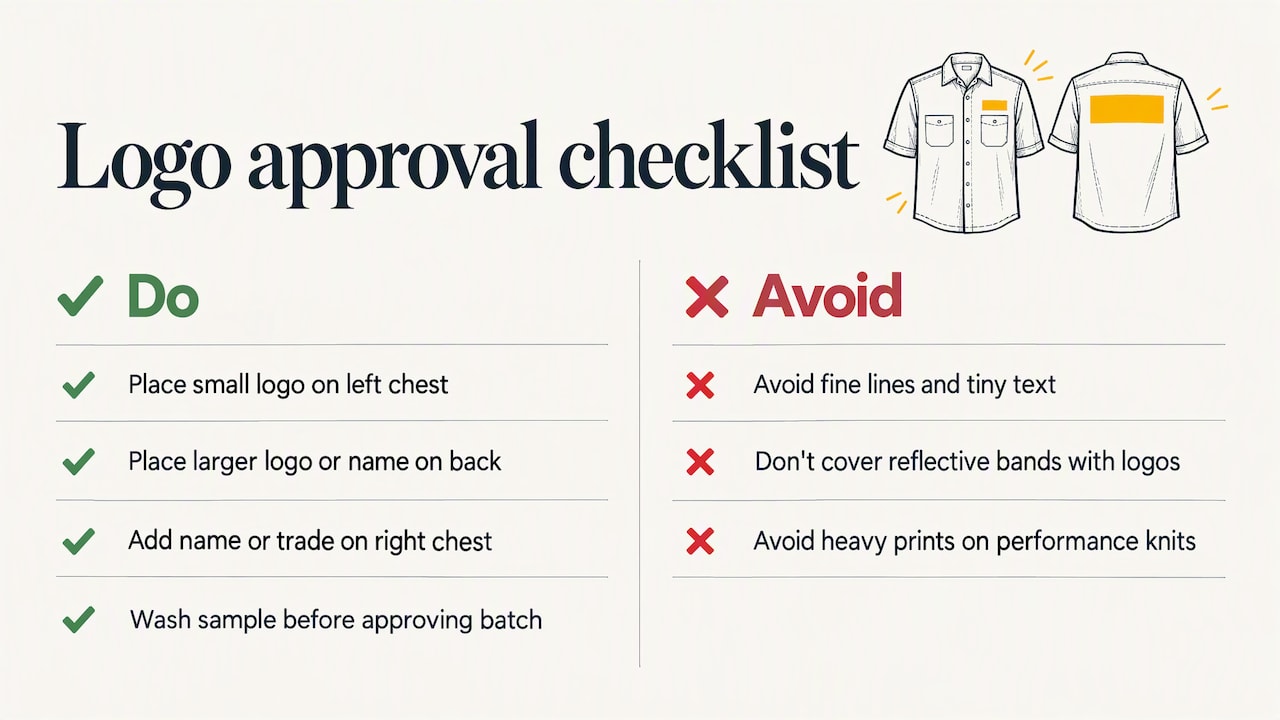
Placement. The usual layout is a small company logo on the left chest, a larger logo or company name across the back so workers are identifiable from a distance, and optionally a name or trade on the right chest. Keep the print clear of seams, pocket edges and any reflective bands.
Size and colour. On a light shirt, a dark single-colour logo reads best at a distance and costs less to print than a many-colour design. Avoid fine lines and tiny text, which blur on textured fabric and fade after washing.
Print method. Screen printing, heat-transfer vinyl, direct-to-garment and embroidery each suit different quantities and fabrics. Heavy prints can feel stiff and hot on a breathable fabric, so for a performance knit a lightweight print or a small logo is often the better trade. Our guides on screen printing, DTG and vinyl and choosing a print method explain the differences in plain terms.
Wash performance. Site shirts are washed often. NEA’s uniform guide points to colour-fastness testing under international standards such as ISO 105-B02 or ISO 105-E01 so uniforms stay presentable and do not wash out easily. Ask any printer how a sample holds up after repeated washes, and wash it yourself before approving the batch.
Consistency. A uniform policy keeps the look consistent. The same NEA guide says companies should set uniform policies, supervisors should make sure uniforms are properly worn on duty, and the policy should say what follows non-compliance. Decide how many shirts each worker receives, who pays for replacements, and how new joiners are sized.
For more on corporate and staff uniforms, see our pages on company uniform shirt printing and what to consider for uniform printing.
Our perspective: treat the shirt as part of your safety culture
We print for schools, businesses, non-profits and event teams, and the same lesson comes up again and again: the order goes wrong when the shirt is chosen from a photo and the print is decided last. For a construction crew the cost of that mistake is higher, because the wearer is outdoors in Singapore’s heat all day.
Our advice is to start with the worker, not the logo. Pick a breathable, loose, light-toned shirt that your own crew will actually want to wear, because a shirt left in the locker does nothing for safety or branding. Then design the logo to suit the fabric, keep the artwork simple, and approve a sample before the full run. We manage the process from design through printing, packing and delivery, so your site manager does not need to chase several suppliers.
We do not present printed shirts as protective equipment. If your job needs certified protection or specific hi-vis standards, confirm them with your safety officer first and tell us the requirement, so the branding is planned around it.
— Tommy
Ordering branded work shirts for your crew
A clean ordering sequence avoids reprints and delays.
- Define roles and quantities. Count labour crew, supervisors, office staff and visitors separately, since each may want a different cut or colour.
- Confirm site requirements. Ask your safety officer or main contractor whether any hi-vis or colour rules apply.
- Choose fabric and style. Shortlist two options and compare samples in the heat, not in an air-conditioned showroom.
- Prepare artwork. Send your logo as a vector file if you have one, and say where it should sit.
- Approve a sample. Wear it, wash it, and check the print.
- Collect sizes. Get sizes per worker. Include a small buffer for new hires.
- Plan delivery. Agree whether shirts arrive in one site delivery or packed per team.
Our step-by-step guide from design to delivery walks through what happens at each stage.
Order with us
We offer T-shirt printing, design and planning, printing and packing, and delivery for organisations in Singapore, along with sportswear and dri-fit attire and jackets. If you need a branded crew shirt in a breathable fabric, tell us your headcount, roles and logo, and we will work out the options with you. Prices depend on the project, so we quote per order. See our T-shirt printing services or browse past work in our portfolio.

Caring for work shirts so they last
Good care protects the fit, the colour and the print. These habits apply to most printed shirts, but always follow the care label on the garment you actually receive.
- Wash inside out. This reduces friction on the print and the logo.
- Use cool or warm water and mild detergent. Hot water and harsh products speed up fading and can shrink cotton-rich fabrics.
- Skip fabric softener on performance fabrics. It can coat the fibres and reduce moisture wicking.
- Avoid high-heat drying. Air-dry or use a low setting, especially for shirts with vinyl or reflective detail.
- Wash sweat-heavy shirts promptly. Leaving them damp invites odour and mildew in Singapore’s humidity.
- Rotate the stock. Give each worker at least two or three shirts so none is washed daily.
Replace shirts when seams fail, fabric thins or the logo has faded enough that the worker is hard to identify. A shirt that no longer breathes or fits is worth replacing for comfort alone.
FAQ
What is the best colour for construction work shirts in Singapore?
Light colours are generally recommended, because MOM and the WSH Council advise loose-fitting, light-coloured clothing for hot outdoor work. If your trade is dusty or oily, choose a lighter shade that hides dirt reasonably well, or add darker panels at the cuffs and hem. Wash a sample before ordering the full batch.
Do construction work shirts need to be high-visibility?
Not always. High-visibility features make sense where workers are near vehicles or in dim light, and your safety officer or main contractor will say what applies on your site. Where hi-vis is not required, a breathable light shirt is usually more comfortable.
Can a printed T-shirt be worn on a construction site?
That depends on your site and company policy, and on any requirements from the main contractor. A printed shirt is workwear and not PPE, so it does not replace a helmet, gloves, safety shoes or any certified protective garment. Check your site rules before you order.
How should I add a logo to a work shirt?
Keep it simple: a small left-chest logo and a larger back print is the common layout. Use one or two colours, avoid fine detail, and keep the print away from seams and reflective bands. Approve a sample and wash it before the full run.
Sources
- WSH Council: Managing heat stress in the workplace
- WSH Council: WAH Symposium 2022 Q&A responses
- MOM: Summary of WSH guidelines on adverse weather recommendations (2025)
- MOM: Written answer to PQ on stop work during hot weather (6 March 2024)
- MOM: Heat stress framework for outdoor workers
- MOM: WSH tech resource guide, construction sector
- NEA: Guide on uniforms for the environmental services industry (December 2022)
- Singapore Police Force: Recommended design and layout of security officer uniform
- Smart work wear to enhance construction workers’ health and safety (2020)
- The development of anti-heat stress clothing for construction workers (2016)