An organic cotton T-shirt is made from cotton grown under organic farming rules, and the label that proves it is a supply-chain certification such as OCS or GOTS, not a line on a hangtag. If you are ordering for a school, a company, a non-profit or an event, the sensible route is to decide what claim you want to make, ask for the certificate behind it, choose a print method that suits the artwork, and order early enough to approve a sample.
Most pages that rank for this keyword are retail listings for single shirts. This guide is for the person who has to put 60, 300 or 1,000 shirts on a team and defend the choice afterwards.
TL;DR
- Organic describes how the cotton was grown, not how the shirt feels. Organic and conventional cotton share the same physical properties.
- Ask for proof: a certificate under the Organic Content Standard (OCS) or the Global Organic Textile Standard (GOTS), tied to the actual garment batch you are buying.
- Screen printing suits repeat designs and larger runs, while digital printing suits detailed, full-colour artwork and small batches. Test a sample on the real shirt.
- Quantity, number of colours, print positions and garment type drive cost and minimum order. Get a written quote for your exact spec.
- Wash a printed sample before you approve the full order.
Table of Contents
- What makes a T-shirt organic cotton
- How to check that a shirt is really certified
- Is organic cotton right for your group?
- Choosing a print method for organic cotton shirts
- What affects cost and minimum order
- Planning the order
- Caring for printed organic cotton
- Order custom shirts with us
- FAQ
- Sources
What makes a T-shirt organic cotton
Organic cotton is defined at the farm. Growers must follow organic rules on soil health and are not allowed to use artificial fertilisers, hazardous synthetic pesticides or GMOs, according to Textile Exchange’s Organic Cotton Market Report. That is the whole difference at source.
Once the fibre is picked, it behaves like any other cotton. Textile Exchange’s classification guide states that organic cotton has the same physical properties and characteristics as conventional cotton, with no differences in use, handfeel or processing. The benefits and impacts differ because of the organic agriculture and production systems behind it.
For a buyer, that has three practical consequences:
- Do not promise a softer or stronger shirt because it is organic. Softness comes from yarn quality, fabric weight, knit and finishing.
- Describe the benefit accurately. “Made with cotton grown under organic farming standards” is a fair line. Vague phrases such as “eco-friendly” invite questions you cannot answer.
- Expect trade-offs to be discussed. Wirecutter’s US-focused review of organic cotton notes that organic crops can have lower yields and, in some circumstances, need more land, water and energy for the same amount of material. It is not a Singapore study, but it shows why a precise claim beats a sweeping one.
If you also want the wider picture of greener garments and ethical production, our article on sustainable T-shirt printing covers it.
How to check that a shirt is really certified
The word “organic” on a product page is a claim. A certificate is evidence. Two labels come up most often.
OCS: organic content, tracked
Textile Exchange’s Organic Content Standard 3.0 is a voluntary, non-food standard. It verifies organically grown material and its chain of custody, from a farm certified to a recognised organic standard through to the final product, using independent certification bodies and annual audits.
In plain terms, OCS answers one question: how much of this product is organic, and can that be traced?
GOTS: organic content plus processing rules
According to Textile Exchange’s quick guide to organic cotton, OCS tracks organic fibre content through production into the final product, while GOTS adds social and environmental requirements for processing. If your brief mentions dyeing, worker conditions or chemical use as well as the fibre, GOTS is the label that speaks to those.
Farm certification is a different thing
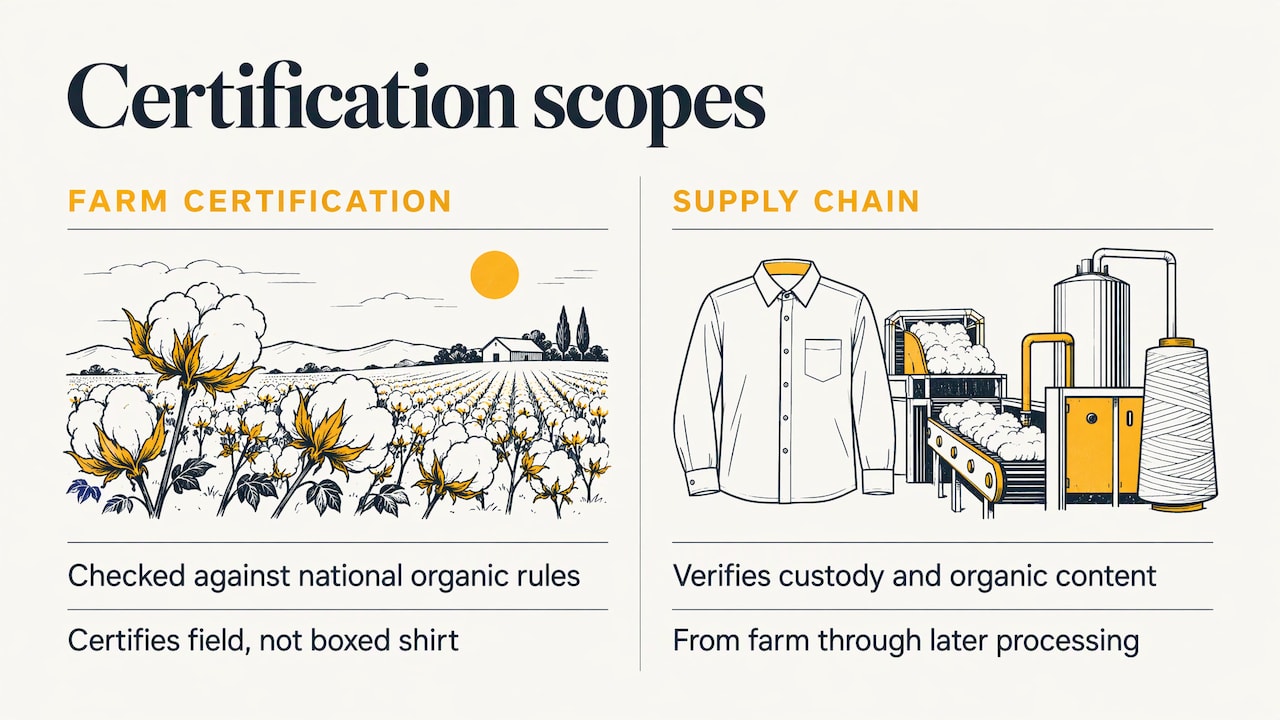
The same 2022 market report separates farm certification, checked against national organic rules, from supply-chain certification such as OCS and GOTS, which verify custody and organic-content claims from the farm through later processing. A supplier saying “our cotton comes from certified farms” has told you something about the field, not about the shirt in your box.
What to ask your printer or supplier
- Which standard covers the blank garment: OCS, GOTS or neither?
- Can you see the certificate, and does it name the manufacturer and cover the product category?
- Is the certificate current, and does the transaction or batch documentation match what you are buying?
- Is the claim about the whole shirt, or a blend that includes non-organic or synthetic fibre?
If the answer to the last question is “a blend”, write the percentage in your communication rather than calling the shirt “organic”.

Is organic cotton right for your group?
The fabric is not the reason to choose it. The message is. Here is how that plays out for the groups we print for.
| Group | Where organic cotton fits | What to watch |
|---|---|---|
| Schools, class and CCA shirts | Sustainability or environmental-education themes, green clubs, house shirts parents will keep | Tight budgets and many sizes, so confirm size range and a single reorder route |
| Companies and teams | CSR days, staff welcome kits, brand values that include sustainability | Any sustainability claim in marketing must be backed by paperwork |
| Non-profits | Environmental or community campaigns where the shirt itself is part of the message | Volunteer sizing and a reprint plan for later joiners |
| Events and conferences | Giveaways delegates will actually wear again | Humid-weather comfort and delivery before the event |
For many events in Singapore, comfort in the heat matters as much as the fibre. Cotton breathes well but holds moisture, while performance fabrics dry faster. If your event involves running or sport, compare the options in our article on dri-fit versus cotton T-shirts. For desk and office wear, cotton tees sit comfortably next to the polo shirts covered in our piece on dri-fit and polo printing for businesses.
Fit, weight and colour
Ask for a garment sample in your size range before you decide. Look at three things:
- Fabric weight. Heavier cotton feels more substantial and is less see-through in white, but is warmer outdoors.
- Cut. A unisex cut is simpler for a large group. Check the smallest and largest sizes offered.
- Colour. Natural, undyed and light shades suit organic messaging, but light colours show sweat and dirt faster. Dark colours may need a different print approach.
Choosing a print method for organic cotton shirts
Printing organic cotton is much like printing any cotton. The fibre takes ink well, so the decision rests on your artwork and quantity. As a general guide from printing practice, screen printing suits repeat designs and larger runs, while direct-to-garment (DTG) printing suits detailed, full-colour artwork and individual designs or small batches. Results depend on the equipment, ink, artwork, garment and production process, so the only reliable test is a sample on your chosen shirt.
| Method | Best for | Think about |
|---|---|---|
| Screen printing | Logos and flat colours, repeat designs, larger runs | Each colour needs its own screen, so many colours add set-up |
| DTG (digital) | Photographic or multi-colour artwork, small batches, names and numbers | Per-shirt cost is less affected by colour count, but suited to smaller quantities |
| Heat transfer | Names, numbers and small personalised additions | Best used for small areas |
If an eco message matters to you, ask the printer about inks and how waste is handled. Do not assume a water-based or “eco” ink exists because the shirt is organic. Ask, and get the answer in writing if you plan to advertise it.
Our guide to choosing the best T-shirt printing method goes through each method in more depth, and designing T-shirts that look great after printing helps non-designers prepare artwork.
What affects cost and minimum order
We do not publish fixed prices because every job differs, so any figure you see in a generic guide should be treated with caution. These are the factors that move a quote:
- Quantity. Set-up work is spread across the run, so unit cost normally falls as quantity rises.
- Number of colours and print positions. A one-colour chest logo is simpler than a full-colour front, back and sleeve.
- Method. Screen printing and digital printing price differently, as explained above.
- Garment. Certified organic blanks usually carry a different cost from standard blanks, and the certificate may limit the colours and sizes available.
- Packing and delivery. Individually named and bagged shirts take longer than bulk cartons. Our printing and packing and delivery services handle this stage.
- Lead time. A tight deadline limits your choice of garment, because certified blanks may need to be sourced.
Minimum order depends on the garment and method, so ask for it when you request a quote. A useful brief includes quantity by size, the artwork file, the print positions, the date you need the shirts and whether certification paperwork is needed.
Planning the order
Work backwards from your event or term start.
- Define the claim. Do you want organic fibre, certified processing or just a softer, natural look? This determines the paperwork.
- Count sizes. Collect sizes early, with a small buffer for late joiners.
- Send artwork and agree the method. Share vector files if you have them.
- Approve a sample or proof. Check print placement, colour and the shirt itself.
- Wash test. Launder the sample as your recipients will. Wash-care outcomes depend on the garment, print system, curing and laundering conditions, so test before committing the full run.
- Confirm delivery. Agree the address, the date and whether shirts are packed by person, class or team.
Our article on the T-shirt design process from concept to cotton shows what each stage involves, and the complete guide to custom T-shirt printing in Singapore covers the basics for first-time buyers.
If the shirts will be sold on
Some clubs and societies print shirts to sell to members as fundraisers. If that is your plan, a guide to selling team merchandise online explains how to limit upfront risk, and it pairs well with a pre-order model so you print only what is already paid for.
Caring for printed organic cotton
Give recipients simple care instructions on a card or in the handover email. Good habits are standard for printed cotton: turn the shirt inside out, wash on a gentle cycle in cool water, avoid harsh bleach and hot tumble drying, and iron on the reverse side or away from the print. Follow the instructions the printer gives for your specific print system, because curing and ink type affect how a design holds up. A sample wash before the full order is the best way to confirm it.
Our view on organic cotton orders
Organic cotton is worth considering when the shirt carries a message about care for people or the planet. It is not worth considering as a shortcut to a better-feeling shirt, because the fibre behaves like any other cotton.
We manage the whole job, from design and planning to printing, packing and delivery, and we customise the design, the material and the delivery to each brief. For a group order, that means we start from your purpose: who wears it, where, how often and what you want to say. Then we recommend the garment and print method that fit.
Our advice is simple. Decide your claim first, ask for the certificate behind it, and approve a printed sample before the full run. That keeps an organic order honest and keeps your team confident wearing it.
Tommy
Order custom shirts with us
We print and deliver custom apparel for schools, businesses, non-profits and event organisers across Singapore, including class and CCA shirts, event and conference tees, sports attire and windbreaker jackets. Tell us your quantity, deadline and whether you need certified organic cotton, and we will advise on the best option for your brief.

See examples in our T-shirt printing portfolio, or start your order on our website. Planning an event? Our event T-shirt printing service and guide to school camp T-shirt printing cover the details.
FAQ
Is organic cotton softer than regular cotton?
Not by virtue of being organic. Textile Exchange notes that organic and conventional cotton have the same physical properties, with no difference in handfeel or processing. Softness depends on yarn, fabric weight, knit and finishing, so judge a shirt by touching a sample.
Can you print on organic cotton T-shirts?
Yes. Organic cotton takes screen printing and digital printing like other cotton. The best method depends on your artwork and quantity, so ask for a sample on your chosen garment and wash it before approving the order.
How do I know a shirt is certified organic?
Ask for the OCS or GOTS certificate and check that it covers the manufacturer and the product. OCS verifies organic content and chain of custody, while GOTS adds social and environmental processing requirements.
Is organic cotton worth it for school or company uniforms?
It is worth it when sustainability is part of your message and you can back the claim with paperwork. If the main need is a durable, comfortable uniform at a set budget, compare it with other cotton and performance options before deciding.
What should I send for a quote?
Send your quantity by size, artwork, print positions, required date and any certification needs. With those details, we can give you a quote that fits your exact specification.
Sources
- Textile Exchange, Organic Cotton Market Report 2022
- Textile Exchange, Organic Cotton Fibre Classification Guide
- Textile Exchange, Organic Content Standard 3.0
- Textile Exchange, Quick Guide to Organic Cotton
- Wirecutter, Is Organic Cotton Really Better?