A recycled fabric shirt is made from fibre that began as waste, most often plastic bottles turned into polyester, sometimes blended with cotton. For a school, company, charity or event team ordering printed shirts in bulk, the real question is not whether such shirts exist. It is how to specify one clearly enough that the shirts you receive match the recycled claim you want to print on your own communications. This guide covers what the term means, how the fabric is made, how it behaves with printing, and how to write a brief that gets you what you expect. We manage printed apparel orders from design to delivery, and a clear brief is where a good order starts.
TL;DR
- Recycled fabric means old material has been broken down and rebuilt into new fibre. Upcycled means an existing garment or fabric is reused as it is.
- Most recycled shirts are polyester (rPET) from plastic bottles, often blended with cotton. Fully 100% recycled garments are uncommon.
- A label that says only “made with recycled materials” tells you little. Specify a percentage, such as 50% recycled polyester, in your brief.
- Certification matters because recycled polyester cannot be told apart from ordinary polyester by touch or sight.
- Tell your printer about the recycled requirement at the start, with your design, quantity and delivery date.
Table of Contents
- What “recycled fabric” means in a shirt
- What recycled shirts are actually made from
- How recycled fabric behaves for uniforms and events
- Reading the label: how to avoid vague recycled claims
- Does a recycled shirt suit your group?
- How to specify recycled fabric shirts in a printing brief
- Recycled, upcycled or conventional: choosing by need
- Perspective: what we tell teams who ask about recycled fabric
- Plan your recycled-fabric order with us
- FAQ
- Sources
What “recycled fabric” means in a shirt
The phrase gets used loosely, so it helps to separate three ideas.
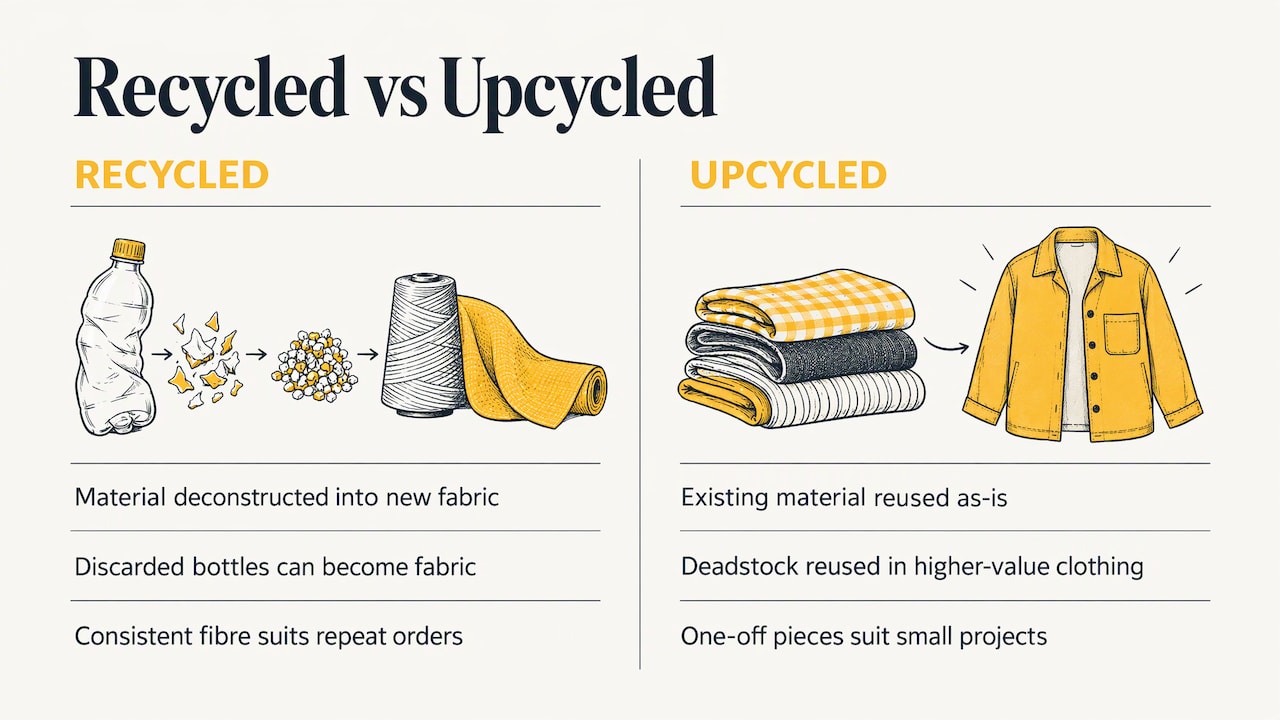
Recycled: according to Project Cece’s guide to recycled fabrics, recycling in fashion means completely deconstructing a material and making it into new material suitable for clothes, for example turning plastic from discarded bottles into fabric.
Upcycled: the same guide describes upcycling as extending the life of a specific piece of material, such as unwanted clothes or deadstock (unsold fabric left over from production), by reusing it as it is in a garment of higher value. Upcycled pieces do not always come from recycled fabric, and each one tends to be one of a kind.
Why that matters to a bulk buyer: a team of 80 students or 300 conference volunteers needs the same shirt in every size, repeated if you reorder. Upcycled, one-off pieces suit a small design project. Recycled fibre, made as a consistent fabric, is the route that fits a uniform order. Fibre2Fashion’s industry article draws the same line: recycling returns materials to a new life phase, while upcycling adds value to what already exists and often needs a complete manufacturing cycle of its own.
The search terms “recycled material t shirts” and “recycled fabric apparel” point to the same family of products. In practice, they cover recycled polyester, recycled cotton and blends of the two.
What recycled shirts are actually made from
Recycled polyester from bottles
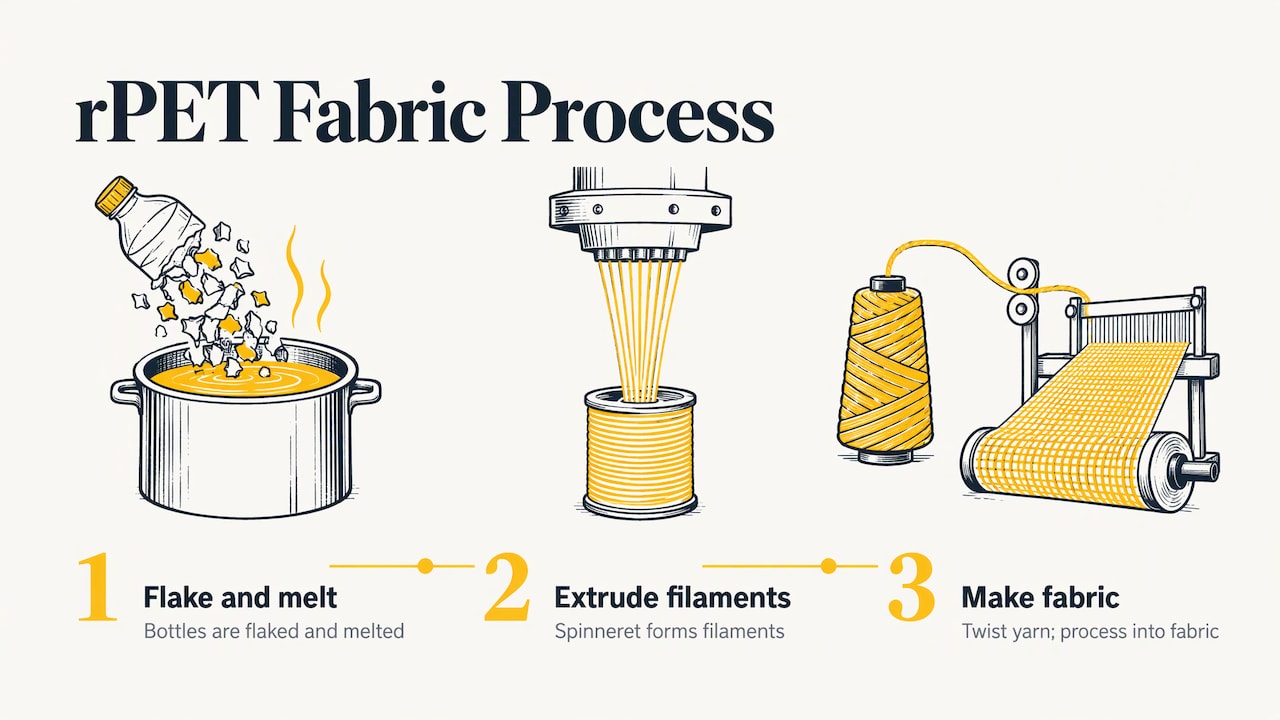
The most common route is rPET, recycled polyethylene terephthalate. The Museum of Design in Plastics explains the process: bottles are flaked and melted, then forced through a spinneret (a plate with tiny holes) to form filaments. These are twisted into yarn and processed into fabric.
The same source notes that garments are rarely 100% recycled. Supply of post-consumer bottles is unreliable, and high-performance, non-scratchy fabric needs long fibres. It gives the example of a jacket with 87% recycled content, which saves just under 15 kg of CO2 compared with a garment made entirely from virgin material.
For shirts, this means the polyester you meet in sports tees, event shirts and polos can have a recycled version that looks and feels much the same. It also means a blend is the realistic expectation, not a flaw.
Recycled textile waste
The other route turns old textiles into new yarn. Ecocult explains that mechanical recycling shreds and spins textile waste into new yarn, which usually gives shorter, weaker fibres. Chemical recycling can rebuild fibre of the same quality. The same article estimates that less than 1% of global textile waste is recycled back into fashion. This is why you will see far more bottle-based polyester than cotton-from-old-cotton on the market today.
What this means for your order
| Material | Where it comes from | What to expect in a uniform order |
|---|---|---|
| Recycled polyester (rPET) | Post-consumer plastic bottles | The most widely available recycled option, suited to sports, event and activity shirts |
| Recycled polyester and cotton blend | Bottle-based fibre blended with cotton | A softer feel than pure polyester, with the recycled share set by the blend |
| Recycled cotton | Textile waste, mechanically recycled | Shorter fibres, so it is usually blended with another fibre |
| Upcycled fabric or garments | Existing garments or deadstock | One-of-a-kind pieces, rarely suited to matched team sizes |
How recycled fabric behaves for uniforms and events
Teams ask three practical things: is it comfortable, will it last, and will the print look right.
Performance. VNPolyfiber’s rPET guide states that certified recycled polyester delivers performance equivalent to virgin polyester for most commercial applications. It gives tensile strength (how much pulling force a fibre withstands) of 3.5 to 7.0 grams per denier for mechanically recycled fibre, and up to 9.0 for fibre processed further or chemically recycled. For a CCA shirt that is washed weekly or a run shirt worn once a year, that points to a fabric that holds up like its conventional counterpart.
Comfort. Because recycled polyester is polyester, its comfort profile follows the fabric construction: a lightweight knit with moisture-wicking finish suits sport and heat, while a cotton blend feels softer against the skin. Singapore’s climate is the deciding factor here. Our guide on Dri-Fit versus cotton shirts walks through that choice, and the same logic applies when the fabric is recycled.
Print. The print method follows the fabric, whether the fibre is recycled or not. Polyester and cotton blends take screen printing, DTG (direct-to-garment, where ink is printed straight onto the shirt) and heat-applied vinyl differently, which is why we set out the options in screen printing vs DTG vs vinyl. Settle fabric and method together, with your artwork, before you approve a quantity.

Reading the label: how to avoid vague recycled claims
The hardest part of buying recycled apparel is not the fabric. It is knowing what you were sold.
VNPolyfiber points out that recycled polyester is physically indistinguishable from virgin polyester without chemical analysis. That is why certification, not appearance, carries the claim.
The Singapore Fashion Council’s Sectoral Plan for Sustainable Fashion Leadership in Singapore and ASEAN, published in September 2026, advises brands to replace broad statements with quantifiable details, such as “50% recycled polyester”, and to share traceability information on the materials used. You can apply the same standard to your own order. Write down:
- The fibre and its share. For example, 50% recycled polyester and 50% cotton, rather than “eco fabric”.
- The certification, if you need one. VNPolyfiber says the Global Recycled Standard issues a transaction certificate for each shipment and recommends requesting the certificate for the specific shipment, not just a general scope certificate. It also says OEKO-TEX Standard 100 covers chemical safety, with Class I for children’s products and Class II for items worn against adult skin. Schools ordering for young pupils may find the Class I reference useful.
- The wording you plan to use. If your event page will say “made from recycled materials”, the shirts need to support the exact figure.
A few distinctions help you read other people’s claims too. Project Cece notes that recycled polyester still sheds microplastics when washed. The Museum of Design in Plastics and Ecocult both show that fully recycled garments are the exception. Treat your recycled shirt as a good-practice improvement to a uniform, and describe it accurately in your communications, with its real percentage.
Does a recycled shirt suit your group?
Schools, CCAs and camps
Class and CCA shirts are ordered in many sizes, often to a fixed budget and a fixed date. A recycled blend can fit this if the specification is settled early: fabric, percentage, sizes, print areas. If recycled content links to a school sustainability or environmental education theme, a documented percentage gives teachers something concrete to explain. Our page on T-shirt printing for schools, CCAs and camps covers the ordering questions that come before fabric.
Businesses and team uniforms
Corporate teams often want a uniform that reflects company values, and recycled fabric can support that. The condition is that the claim is specific, which the Singapore Fashion Council’s guidance on quantified wording supports. A line such as “our team shirts are 50% recycled polyester” is easier to stand behind than a general green claim. Our article on custom printing as a marketing tool shows why the shirt itself is worth getting right.
Non-profits
For volunteers and fundraising merchandise, the shirt is part of your message. A recycled fabric choice with an exact figure fits that message. Keep the claim as modest as the evidence: say what the shirt contains, not that it solves a waste problem.
Event organisers
Event shirts are worn briefly by many people, often with a large front print and a sponsor panel on the sleeve or back. Fabric choice affects how the print sits and how people feel in the heat, so confirm both before you commit to a quantity. See our event T-shirt printing page for how event orders are planned.
How to specify recycled fabric shirts in a printing brief
This is the routine we suggest, and where we take work off your hands.
- Decide what the recycled choice is for. Is it a sustainability theme, a procurement requirement, or a talking point for sponsors? The purpose tells you how exact the proof needs to be.
- Set the garment first. Round neck tee, polo, sports shirt, windbreaker. The garment type narrows which fabrics are realistic. We offer printing across T-shirts, sportswear, jackets and more, so you can settle the whole kit in one brief.
- Name the fibre and the share. Use the same quantified style recommended by the Singapore Fashion Council: the fibre, and the percentage.
- State any certification you need. Include it in the brief from the start, so it is not an afterthought once shirts are cut. Where a shipment-level certificate is part of your requirement, say so.
- Match the print method to the fabric. Our customisation covers design, material and delivery, so your design, fabric and print method are planned together. Our design process guide shows how a concept becomes a print-ready file.
- Plan the timeline. Add time for design approval, production and delivery. Our step-by-step guide from design to delivery lays out the stages.
- Approve the design, then produce. Our orders are fulfilled after design approval, so the specification you settle at the start is the one that is produced.
Our wider article on sustainable T-shirt printing in 2026 covers eco-friendly materials and ethical production more broadly.
Recycled, upcycled or conventional: choosing by need
| Your need | Best-fitting choice |
|---|---|
| Hundreds of matching shirts in set sizes | Recycled polyester or recycled blend, specified by percentage |
| A small run with a one-off story | Upcycled pieces, accepting that each will differ |
| A sports or outdoor team in Singapore’s heat | A recycled polyester performance knit |
| Young pupils wearing the shirt daily | A blend with the safety certification you require, confirmed in the brief |
| A tight deadline | Settle fabric and design first, because the specification drives production time |
Perspective: what we tell teams who ask about recycled fabric
Most groups that come to us are not looking for a fashion label. They need the same shirt on every person, a print that looks sharp, and delivery that lands before the event. Recycled fabric belongs in that conversation when it is specified with the same discipline as everything else: a fibre, a percentage, a size run and a date.
What we can offer is the thing that makes any fabric choice work: managing the whole process from design to distribution. Our service covers full customisation of design, material and delivery, so when you bring us a requirement, we plan the artwork, the print method and the logistics around it. That is how a team ends up with shirts that look like the sketch.
Our advice is simple. Decide early, write the figure down, and let the brief carry it through the order. A clear brief protects your schedule and your message.
Tommy
Plan your recycled-fabric order with us
If your school, company, charity or event needs printed shirts, jackets or sportswear, start with your design and quantity and add your fabric requirement to the brief. We take the order from design through printing, packing and delivery.

Browse our T-shirt printing portfolio to see finished work, or take your brief to Singapore T-Shirt Printing Services to get your project started.
FAQ
Are there shirts made from recycled plastic bottles?
Yes. Recycled polyester is commonly made from plastic bottles that are flaked, melted and extruded into filaments, then twisted into yarn and knitted or woven into fabric, as the Museum of Design in Plastics describes. Many shirts are blends with cotton rather than 100% recycled.
What is the difference between recycled and upcycled shirts?
Recycled fabric has been broken down and rebuilt into new material. Upcycled clothing reuses an existing garment or fabric as it is, in a form of higher value, according to Project Cece. Upcycled pieces tend to be one of a kind, so recycled fibre is the more practical route for matching team shirts.
How do I know how much of a shirt is recycled?
Ask for the fibre and its share in figures, such as 50% recycled polyester, which is the style of wording the Singapore Fashion Council recommends. Recycled polyester looks the same as ordinary polyester, so the figure and any certification are what carry the claim. Put both in your order brief.
Can recycled fabric shirts be printed like normal shirts?
Yes, but the print method should be chosen with the fabric. Polyester, cotton and blends respond differently to screen printing, DTG and vinyl, so settle fabric, artwork and method together before approving production.
Sources
- Recycled Fabrics & Upcycling Fashion: Green or Greenwashed? (Project Cece)
- Recycling and Upcycling in the Apparel Industry (Fibre2Fashion)
- Recycled fabrics (Museum of Design in Plastics)
- What Circular Fashion, Recycling, Upcycling, and Downcycling Mean (Ecocult)
- Recycled Polyester (rPET): Complete Guide (VNPolyfiber)
- Sectoral Plan for Sustainable Fashion Leadership in Singapore and ASEAN (Singapore Fashion Council)