The best running event shirt for Singapore is a lightweight, breathable synthetic tee with a clean, high-contrast design. It should be ordered in a sensible size mix and approved well before race day. This guide is for organisers of school runs, company charity runs and community races. It covers fabric, design, print method, sizing, quantities, timelines and care, so the shirt your participants wear is one they actually want to put on.
TL;DR
- Choose lightweight synthetic fabric, not heavy cotton. Singapore’s humidity makes wet cotton heavy, warm and prone to chafing.
- Keep the design simple: one or two strong colours, a bold event mark and big, legible type. Shirts are worn, photographed and shared long after the race.
- Match the print method to the fabric and the artwork, and confirm it with your printer before you approve a proof.
- Plan sizes from your registration data, add a buffer for staff and volunteers, and work backwards from race day to set your artwork deadline.
- Share the care instructions with runners, so the print and the fabric last beyond one event.
Table of Contents
- What makes a running event shirt different from a normal custom tee
- Choosing fabric for Singapore’s heat and humidity
- Designing a shirt people want to wear again
- Print and decoration methods for running shirts
- Sizes and quantities
- Timeline: working backwards from race day
- Looking after the shirt: care that preserves print and fabric
- Perspective: why we push organisers to decide early
- Ordering running event shirts with us
- FAQ
- Sources
What makes a running event shirt different from a normal custom tee
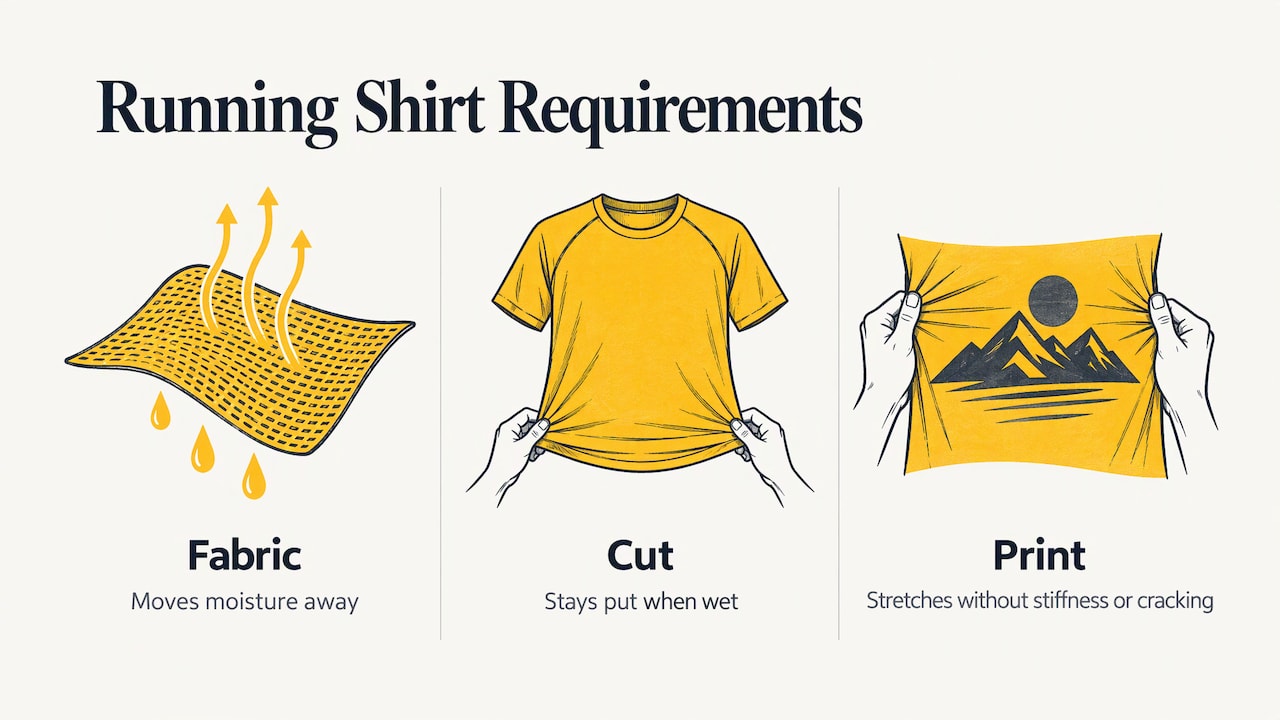
A promotional tee is worn at a booth or a dinner. A running shirt is worn for kilometres, in sweat, often in sun, and then it is worn again as a keepsake. That changes three decisions: the fabric, the cut and the print.
The fabric has to move moisture. The cut has to stay put when wet. The print must not feel stiff or crack when the shirt stretches across a runner’s back. Everything below follows from those three points.
If you are new to ordering event apparel, our planning guide for custom event shirts covers the general workflow. This article goes deeper on what is specific to running.
Choosing fabric for Singapore’s heat and humidity
Singapore is hard on shirts. One technical guide published for the local market notes that relative humidity here frequently exceeds 80%, which compromises sweat evaporation. Its advice is to choose lightweight synthetics and keep elastane under 10%. It also says cotton can absorb up to 25% of its weight in water, and a wet cotton shirt traps heat, sags and causes chafing.
For a participant shirt, that points to a polyester-based, moisture-wicking knit. Two real-world reference points show what runners already expect:
- One sportswear brand’s Singapore listing describes a 100% recycled polyester running top at S$95 with mesh zones front and back and side hem vents for airflow.
- Another lists a 100% polyester short-sleeve tee at S$35 that is fast-drying and moisture-wicking, with a loose, fuller cut.
Those are retail shirts, not an organiser’s budget. They do show that the gap between a premium and an everyday running tee is mostly in the construction details, and that the basic wicking polyester is the common thread.
Fabric weight and breathability
Weight matters in humidity. A 2026 guide on humid-weather running tops recommends a GSM below 120 so the garment stays light and breathable even when humidity passes 90%. The Singapore-focused guide above suggests checking the specification and aiming for shirts under 100 grams in a standard size.
When you request a quote, ask for the fabric weight and composition of each shirt option. It is the simplest way to compare two samples that look identical.
Fit and features that help on the course
A review of running shirts from 2025 says that on race day a close-to-body fit usually makes the most sense. It also notes that a shirt soaked in sweat tends to sag at the hem, and that side venting, perforated holes and mesh zones set better shirts apart. Not all synthetics wick and evaporate equally, so a fabric label alone does not settle it.
For hot weather, a Singapore running guide lists lightweight fabrics, cuts that allow airflow, and bonded or flatlock seams to prevent chafing, plus reflective elements for early-morning or evening runs.
Two practical conclusions for organisers:
- Pick a regular, athletic-cut tee over a boxy promotional cut if most participants will actually run in it.
- Seams, neck and underarm comfort matter more than they look on a proof. Runners notice chafing on longer runs, so it helps to tell participants to wear their shirt on a training run before event day.
Designing a shirt people want to wear again
A good event shirt does two jobs: it identifies participants on the course, and it becomes the memento. The design brief should serve both.
Colour
Pick colours that read well outdoors, in photos and against Singapore’s bright sky. A strong base colour with one contrasting accent is easier to print cleanly and easier to spot in a crowd than a busy palette. Colour also helps you separate groups: participants in one colour, marshals and volunteers in another, so they can be found at a glance.
The 2026 BYD Singapore International Marathon is a useful local example. Its new identity pairs a vivid red for Singaporean pride with a bright electric blue for movement, plus a subtle dot pattern inspired by sweat and fabric. The organisers designed the system to be worn, shared and claimed by runners, spectators and every participant. The lesson scales down to a school or company run: a clear emblem, two confident colours and one understated detail.
Layout and branding
- Front: the event name or emblem, large and simple. Fine detail can disappear on a moving, stretching fabric.
- Back: a good place for sponsor logos, the year and the distance. Sponsors often want the back because it is what other runners see.
- Sleeve or hem: small marks such as a hashtag or a school crest.
- Names or bib numbers: only if you can manage the extra data and production time.
Limit the number of sponsor logos. Too many shrink everything and crowd the shirt, which hurts the sponsor and the wearer.
Our guides on choosing the right T-shirt design for your event and designing shirts that look great after printing go through artwork formats, resolution and common mistakes.

Print and decoration methods for running shirts
The right method depends on the fabric, the number of colours in the artwork and the quantity. In general terms:
| Method | Where it suits | Trade-offs to discuss |
|---|---|---|
| Screen printing | Larger runs with a few solid colours | Setup per colour; less suited to photographic artwork |
| Digital printing (DTG) | Detailed or multi-colour artwork, smaller runs | Works best on certain fabrics; confirm suitability for synthetics |
| Heat transfer vinyl | Names, numbers, small logos | Can feel heavier on a very light fabric if used over large areas |
The key running-specific question is how the print behaves on a lightweight, stretchy synthetic. Large, thick solid blocks of ink on the chest can reduce breathability and feel warm, so keep big graphics light or limit the print area where possible. Ask your printer which method they recommend for the exact fabric you have chosen, and request a sample or proof before committing.
For a side-by-side look, see our comparison of screen printing, DTG and vinyl, or our broader guide on choosing the best printing method.
Sizes and quantities
Underordering sizes causes more event-day stress than almost any other shirt problem. A simple approach:
- Start from registration. Collect the shirt size at sign-up, not later. Every runner then has a confirmed size.
- Count the non-runners. Add staff, marshals, volunteers, medical teams, sponsors and guests of honour. They are easy to forget and often want a different colour.
- Add a buffer. Keep a small reserve for late registrations, replacements and walk-ups. The share depends on your event, so base it on your own past turnout.
- Offer a full size range. Include children’s sizes for family and school runs, and consider women’s cuts if your participants are mixed.
- Publish a size chart. Put actual chest measurements next to each size, so runners can compare against a shirt they already own.
If your event is for a school or CCA, our guide to school CCA T-shirt printing covers class-based size collection.
Timeline: working backwards from race day
The schedule is set by the longest stage you cannot compress. Work backwards from race-kit collection, not from race day itself, because shirts usually go into the kit.
- Kit collection date. The date shirts must be physically with you, counted, sorted and bagged.
- Delivery. Allow time for transport and a buffer for delays.
- Printing and packing. Larger quantities and multiple sizes take longer to produce and pack.
- Proof approval. Your sign-off starts the clock. A slow approval is the most common reason a schedule slips.
- Artwork and sponsor logos. Chase every sponsor for vector logos early.
- Final quantities and sizes. Lock registration for shirts before ordering.
We do not publish a fixed turnaround because it depends on quantity, fabric availability and print method. Tell us your kit-collection date and we will confirm a realistic schedule for your order. Build in extra days beyond what is quoted.
Looking after the shirt: care that preserves print and fabric
This is worth printing on the kit insert or the post-race email. A Singapore sports guide advises using a mild liquid detergent and avoiding fabric softeners. It explains that softeners leave a waxy residue that coats fibres, locks in odours and blocks moisture absorption. It also recommends air-drying in a well-ventilated area away from direct, intense sunlight.
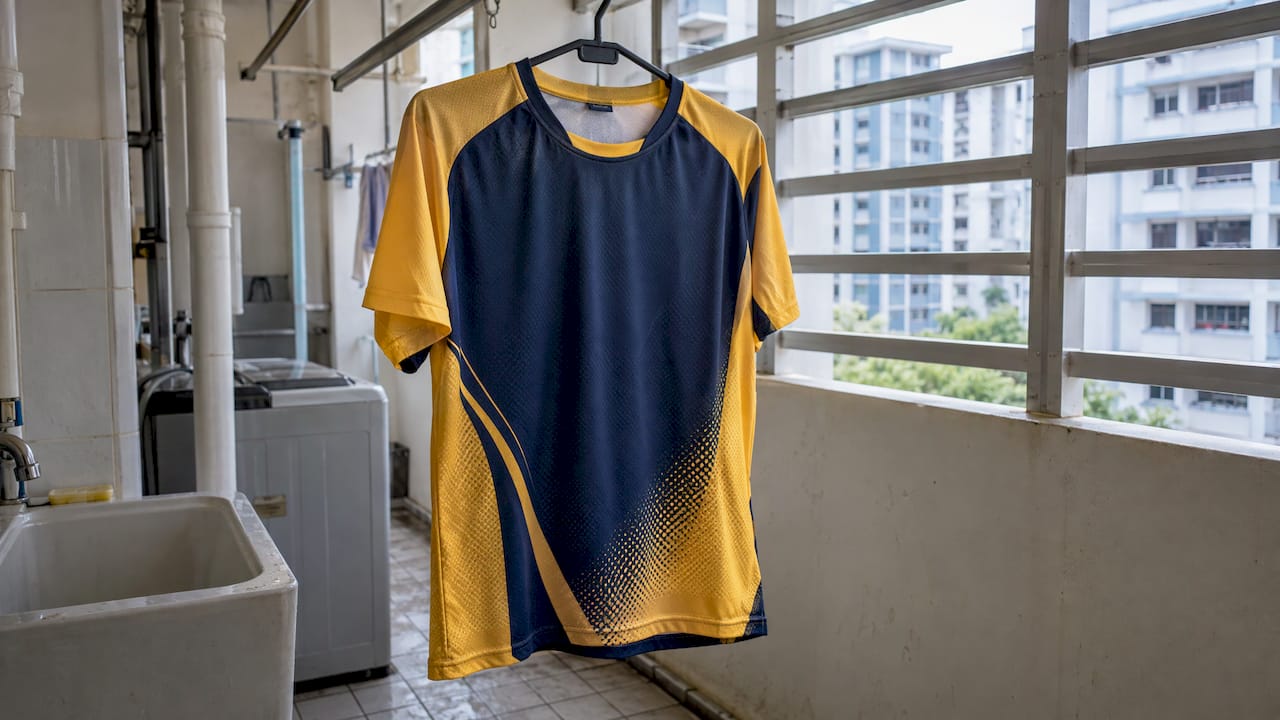
Also check the garment’s own care label, because it takes precedence for your specific shirt.
Perspective: why we push organisers to decide early
Most of the problems we see with running shirts are decided weeks before printing starts: the fabric picked from a photo, the artwork sent as a screenshot, or sizes guessed. We would rather help you settle these early.
Our approach is to handle the whole process, from design and planning to printing, packing and delivery, so your team is not juggling several suppliers. We work with schools, businesses and non-profits, and every order is customised to the group’s identity and purpose: the design, the material and how it reaches you.
For a run, we encourage a simple design, a fabric chosen for comfort in heat, and a proof signed off with time to spare. A shirt that feels good and looks sharp is the one runners keep wearing, and that carries your event’s name further than any banner.
Tommy
Ordering running event shirts with us
We design, print, pack and deliver custom apparel for schools, companies, non-profits and event organisers across Singapore. For a running event that can mean participant tees, volunteer shirts in a second colour, sports caps and attire, or windbreaker jackets for a university or polytechnic team.

Send us your event date, estimated headcount and any artwork you have. See our event T-shirt printing service, look through the printing portfolio for examples, or start from the main site to request a quote. Prices depend on your specification, so we quote per project.
FAQ
Is cotton or polyester better for a running event shirt in Singapore?
For running, lightweight polyester-based fabric is the usual choice. Guidance written for Singapore’s climate says that cotton absorbs water, then turns heavy, warm and chafe-prone when wet. Cotton can still suit a casual walk, a fun run with a lot of spectators or a shirt meant mainly as a souvenir.
What is the best colour for custom running shirts?
Choose one strong base colour with a contrasting accent, so the shirt stands out outdoors and in photos. Use a second colour for volunteers and marshals so participants can find them quickly. Keep the artwork to a few solid colours for the cleanest result.
How many shirts should I order for a running event?
Start with confirmed registrations and their sizes, then add staff, marshals, volunteers and sponsors. Keep a small reserve for late sign-ups, based on your previous turnout. Tell your printer the final size breakdown before approving the order.
How early should I place the order?
Work backwards from the date you need shirts in hand for kit collection, and leave extra time for proof approval and delivery. Turnaround depends on quantity, fabric and print method, so contact us with your dates for a realistic schedule.
Sources
- Choosing Breathable Running Apparel and Accessories for Singapore’s Humid Climate (Lazada Sports SG)
- Stride Aero-FIT Men’s Short-Sleeve Running Top (Nike SG)
- UA Tech 2.0 Men’s Short Sleeve (Under Armour SG)
- Best Tops for Running in Humidity (2XU)
- The Best Men’s Running Shirts of 2026 (The Quality Edit)
- What to wear running: Hot, cold and rain guide (On)
- Proven in Sweat: The New Visual Identity of Singapore International Marathon
- Nipple Chafing on Runs: Test Your Gear on a 3 to 5 Mile Run (SVBFLOR)